
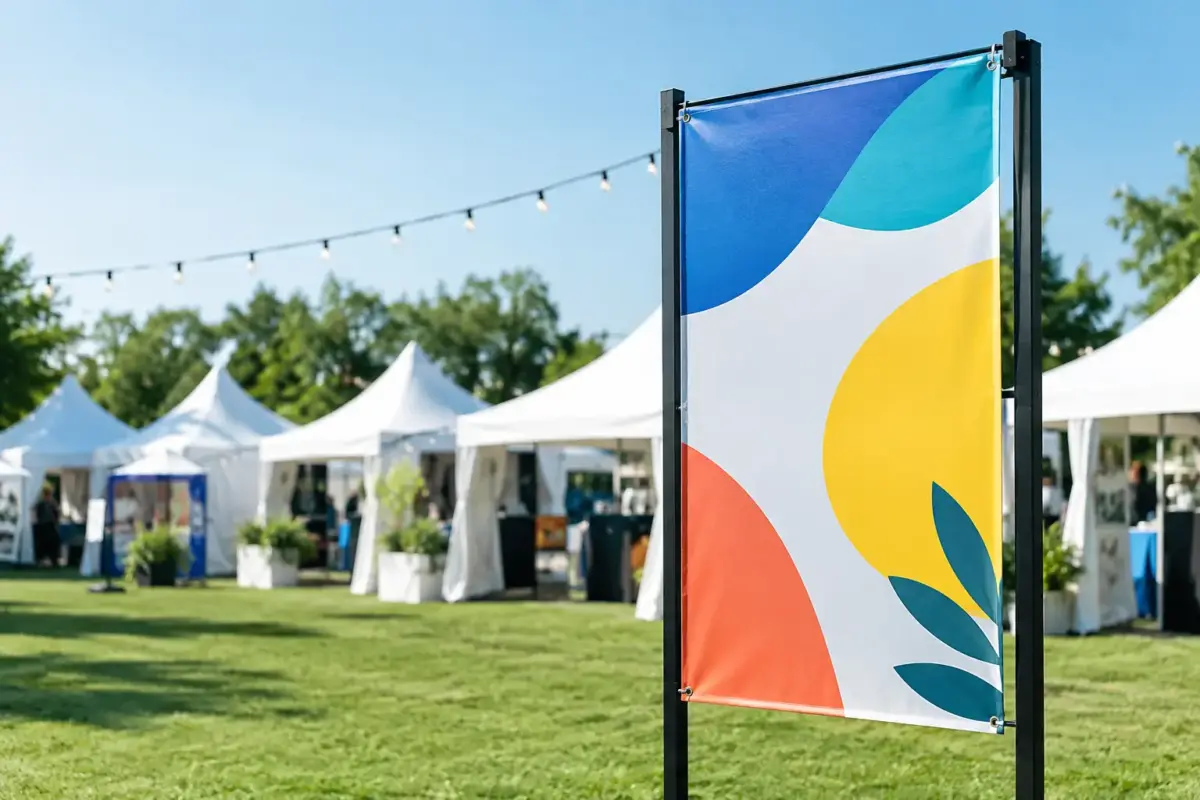
A crowded event site gives people seconds to work out who you are, where to go and whether your setup looks worth approaching. The best signage for outdoor events does more than carry a logo. It creates a visible base for your team, holds its shape in changing weather and keeps working from bump-in through to pack-down.
For Australian markets, sporting days, community festivals, field activations and trade events, the strongest result rarely comes from one banner alone. It comes from matching high-impact branded structures with directional signs that people can read while walking, driving or standing in a queue. The right equipment should also be practical: fast to deploy, safe to secure and tough enough to use again next weekend.
What makes the best signage for outdoor events?
Outdoor signage has to compete with sun glare, wind, distance, other exhibitors and a constantly moving audience. A small printed sign might look sharp on a computer screen, then disappear completely across an oval or busy market lane. Scale, placement and structure matter as much as the artwork.
Start by separating what your signage needs to achieve. Your main branded structure should make your organisation recognisable from a distance. Directional signage should help people find registration, food, first aid, merchandise or the correct activity zone. At close range, a counter sign, table cover or wall graphic can provide the detail: offers, QR codes, schedules, social handles or product information.
The most effective setups use this hierarchy. A branded marquee or inflatable arch catches the eye first. Flags and banners draw people towards the site. Walls, table covers and smaller signs give them a reason to stop and a clear next step once they arrive. When every element tries to say everything, none of it gets read.
Visibility is a sizing decision
Choose sign size based on how far away it must work. A message designed to be read from several metres away needs large, simple text, strong contrast and plenty of clear space around it. That is why a full-colour roof print or tall feather flag often earns its place at an outdoor event. It puts your branding above heads, cars and temporary fencing.
For a 3 x 3 m site, a printed pop-up gazebo can become the visual anchor, particularly when paired with roof branding, one or two walls and flags positioned at the open edge. Larger 3 x 4.5 m or 3 x 6 m structures give organisations more frontage and more printable area, but only if the site allocation, transport and crew can support them. Bigger is not automatically better if it blocks pedestrian flow or leaves no room for tie-downs.
Movement makes flags work harder
Teardrop and feather flags are high-value event signage because they add height without demanding a large footprint. Their movement catches peripheral vision, which is useful beside roads, entry gates, sporting fields and busy walkways. They are particularly effective when a marquee roof sits below eye level in a dense event precinct.
There is a trade-off. Flags need the correct base for the surface and conditions. A ground spike suits grass or soil, while a weighted base is the better option for hard ground. They should never be treated as a set-and-forget item in strong wind. Position them so they support the main setup rather than creating a hazard near queues, footpaths or vehicle access.
Build your event signage around a branded shelter
A printed marquee is one of the few event assets that performs two jobs at once. It gives staff and visitors shelter from sun and rain while turning the space into a highly visible brand presence. For councils, schools, race teams, clubs and promotional teams that attend recurring events, that makes it a long-term operational investment rather than disposable signage.
A custom-printed roof is usually the strongest place to lead with your name or logo. It remains visible when the site is busy and it helps people identify your team from different approaches. Printed walls then provide the space for campaign imagery, sponsor logos or a clear product message. A half wall can keep the stand open and welcoming, while a full back wall gives stronger visual coverage and a cleaner backdrop for photos.
Frame quality should sit at the centre of the purchase decision. Outdoor events are not kind to light-duty display gear. Repeated transport, uneven ground, sudden gusts and hurried pack-down expose weak joints, thin legs and poor connectors quickly. A commercial-grade aluminium or steel frame, reinforced joints and compatible tie-down accessories provide a much better platform for your graphics.
Selected heavy-duty 3 x 3 m structures can carry wind ratings up to 100 km/h when correctly secured in line with product guidance. That rating is a performance benchmark, not a reason to ignore weather warnings or event safety requirements. No portable structure should remain deployed when conditions become unsafe. Your team still needs to monitor forecasts, use suitable weights, pegs and tie-downs, and follow the organiser’s instructions.
Choose materials for harsh Australian conditions
Print quality gets attention first, but the fabric and finishing determine how the equipment performs after the first season. Dye-sublimation printing is a strong choice for custom marquees, flags and fabric displays because the colour is embedded into the material rather than sitting as a surface layer. It delivers bold colour, clean detail and a professional finish across large branded areas.
For outdoor use, look beyond the print. Reinforced stitching, quality hardware, durable wall zips and a frame built for regular deployment all affect service life. Consider how the kit will be transported too. Wheely bags, protective storage and replaceable parts are not extras for teams doing dozens of events each year. They reduce damage between jobs and extend the value of the original investment.
Replacement roofs and walls also matter. Campaign branding changes, sponsors rotate and individual components can wear before the entire structure does. Being able to update a printed roof or replace a damaged wall is far more practical than binning a complete setup.
Design for fast recognition, not a brochure on fabric
The best outdoor artwork is simple enough to understand at speed. Use a logo that can be recognised at distance, one clear campaign message and colours that contrast strongly with the background. If your brand colour is dark, pair it with light text. If your logo has fine detail, give it breathing room rather than shrinking it into a crowded corner.
Keep key information at the right height. A roof valance is excellent for names and short messages. A back wall is better for larger imagery and detail seen from inside the site. A table cover can reinforce branding at close range, but it should not be your only sign because people and stock will obscure it.
Think about photography as well. A clean media wall can turn presentations, prizegiving, player sign-ons and community announcements into shareable branded content. For larger activations, an inflatable arch at the entry can set the event boundary and create a natural photo point. These pieces are most effective when the visual system is consistent: the same logo treatment, colours and message across every asset.
Mountain Shade provides free visual mock-ups and design support, which is useful when a logo needs to be adapted across a roof, walls, flags and event collateral. Reviewing the artwork at scale before production helps avoid common problems such as undersized text, awkward logo placement or an important message hidden behind a counter.
Plan placement before you arrive on site
A strong signage kit can still underperform if it is facing the wrong way. Before event day, ask where visitors enter, where queues form, where vehicles approach and which side of your site gets the best sightline. At a market, that may mean placing flags at the front corners and opening the marquee towards pedestrian traffic. At a sporting event, it may mean using flags to define a club area while a printed back wall faces the field or spectator zone.
Also check practical constraints early. Many organisers have rules around maximum structure height, pegging, vehicle movement, emergency exits and weighted bases. A hardstand site may need water weights or steel base weights instead of pegs. A grass site may allow pegging but still require additional ballast. The right solution depends on ground conditions, forecast weather, site rules and the size of your structure.
Give your crew a repeatable pack list: frame, roof, walls, flags, bases, weights, pegs, tie-down straps, mallet, wheely bags and spare hardware. Missing one connector or tie-down can turn a polished activation into a frustrating scramble. For regular events, keep these items together and inspect them before each departure.
Invest where people will notice
Cheap signage can look acceptable for one calm afternoon, but it often costs more when it fades, tears, bends or needs replacing after limited use. Commercial event gear earns its keep through repeat deployment, reliable setup and a brand presentation that stays sharp under pressure.
Start with the asset that solves the biggest job on your site. For most organisations, that is a heavy-duty custom marquee, then flags for reach and walls or table covers for detail. Build from there as your event program grows. A well-secured, properly printed setup tells visitors that your organisation is prepared, professional and ready to do business outdoors.
