
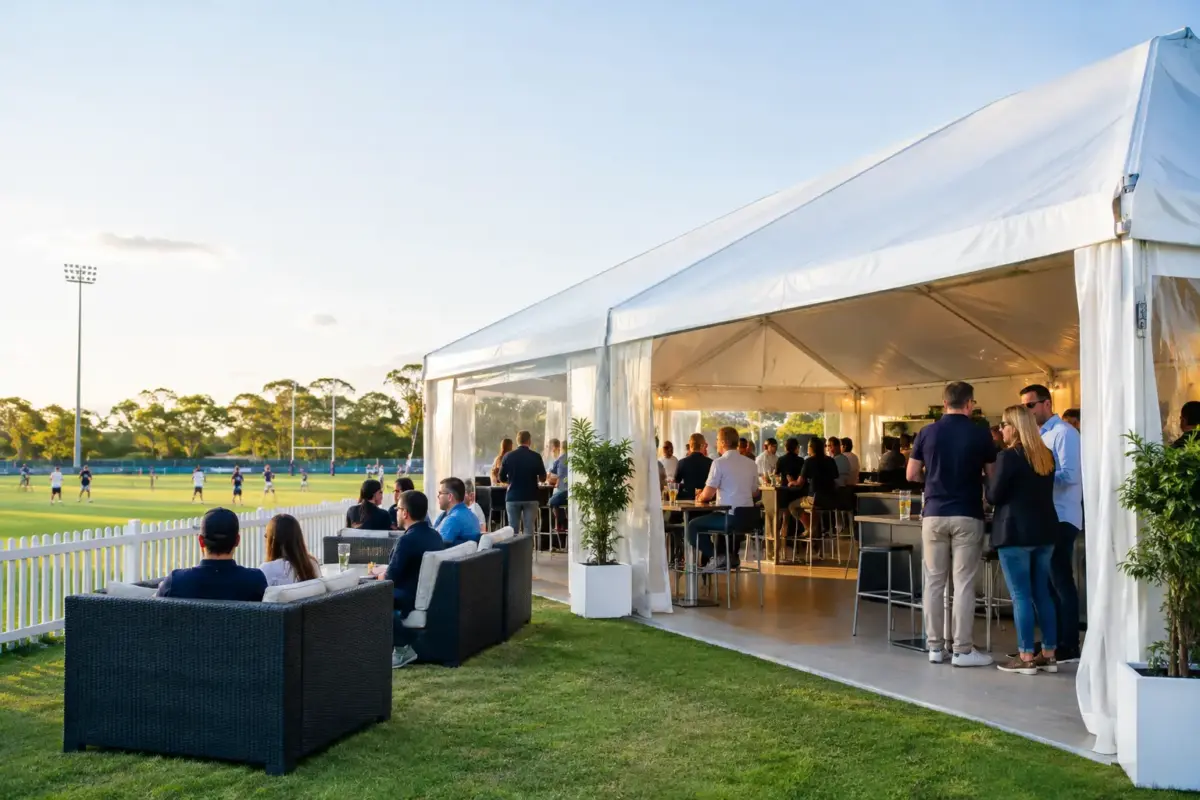
A wet Saturday morning can expose every weak point in a club’s game-day setup. The canteen queue grows, registration sheets get damp, volunteers scramble for cover and sponsors disappear behind a collection of mismatched tents. This sports club marquee case study shows why a purpose-built, branded shelter can change that picture – not just for one fixture, but across an entire season.
The scenario is familiar to community sporting clubs across Australia. A growing junior football club needed better coverage for its home ground. Its existing light-duty gazebo had served a purpose at a few presentations, but it was not up to weekly pack-downs, gusty sidelines or the visual standard expected by sponsors. The club needed a harder-working asset: a shelter for registration, merchandise, first aid and sponsor visibility.
The brief: one marquee, several game-day jobs
The club did not need a marquee simply to keep the rain off. It needed an operational base that could move between the oval, car park and presentation area while making the club look organised.
The requirements were clear. It had to provide enough room for two volunteers, a card terminal, sign-on forms and a small merchandise display. It had to be visible from the entry point, easy to transport in a ute or club trailer, and strong enough to be used regularly rather than treated as disposable event gear. Most importantly, it needed club colours and sponsor branding that looked sharp from a distance.
A 3 x 3 m heavy-duty printed marquee was the logical fit. That footprint gives a useful nine square metres of covered space without taking over the footpath, spectator area or access route. For clubs with larger merchandise ranges, multiple registrations or a busy food service, a 3 x 6 m structure may be the better call. The right size depends on the job, not just the available budget.
Sports club marquee case study: building a stronger setup
The club selected a commercial-grade folding frame with a custom-printed roof and two printed walls. The roof carried the club name and colours across all valances, while the walls featured a major sponsor and a clean club crest. This was not decoration for decoration’s sake. It turned the registration point into a highly visible branded zone.
On arrival, visiting teams and new families could immediately see where to go. Volunteers no longer had to shout directions across the grounds. The registration desk was recognisable from the car park, and the sponsor logo gained repeated exposure through every home game, gala day and presentation event.
The visual result mattered, but the equipment choice mattered more. A commercial marquee frame is built for regular work. Stronger leg profiles, reinforced connectors and premium materials make a real difference when a club is setting up before sunrise, packing down after a long day or operating through unpredictable weather. A cheap frame can look acceptable at first, then become a problem after repeated use, bent components or a missing fitting that cannot be replaced.
For an outdoor sporting environment, the club also included proper anchoring equipment. Pegs can work well on suitable grass, but they are not the full answer for every location. Concrete surrounds, synthetic fields and hard-packed ground call for weight systems. Tie-downs should be part of the setup plan, not an afterthought when the wind picks up.
Selected 3 x 3 m heavy-duty structures can be rated for winds up to 100 km/h when correctly secured according to their specified conditions. That does not mean any marquee should be left standing in severe weather. Clubs still need sensible supervision, correct anchoring and a clear pack-down decision when conditions become unsafe. The value is having a structure engineered for Australian outdoor use, backed by the right accessories and a team that knows how it will be used.
The practical change for volunteers
Within a few rounds, the benefits went beyond shelter. The marquee created a fixed operating point for volunteers. The EFTPOS terminal, float, paperwork, team lists and lost-property tub all had a designated home. That reduced the morning rush and gave new volunteers a clearer handover process.
The printed walls also improved the space in less-than-perfect conditions. One wall blocked the prevailing breeze, while another created a more professional backdrop for membership photos and junior player announcements. On busy mornings, the club could move the table forward and use the rear wall for sponsor messaging. At quieter fixtures, it could remove a wall to keep the setup open and approachable.
This flexibility is one reason folding marquees make sense for clubs. A permanent building may be ideal where the budget and site allow it, but it cannot follow the club to an away carnival, school clinic or local festival. A quality marquee can.
Measuring value beyond the purchase price
A sports club marquee should be judged over seasons, not weekends. The upfront cost of a commercial, custom-printed structure is higher than a basic hardware-store gazebo. That is the trade-off. But a club that uses its shelter every Saturday, at sign-on days, fundraising barbecues, holiday clinics and sponsor events gets far more value from a unit that remains presentable and serviceable.
In this scenario, the club had previously replaced low-cost shelters after damage and wear. The new marquee was purchased as infrastructure. Replacement roofs, walls, wheely bags, weights and spare parts were available if required, which reduced the risk of having to discard the entire setup for one damaged component.
Sponsor value was another important measure. Rather than placing a logo on a temporary sign that only appeared at a presentation night, the club gave its sponsor repeated game-day exposure. The sponsor appeared in team photos, social posts, registration activity and the background of junior presentations. For a local business supporting grassroots sport, that visibility is practical and easy to see.
The club also avoided a common branding mistake: overcrowding every surface. A marquee roof should be readable at a glance. Strong club colours, a clear crest and a sponsor logo positioned with room to breathe will generally outperform a roof covered in small text. The goal is recognition from across the grounds, not a brochure printed on fabric.
Choosing the right package for your club
Every sporting club has different pressure points. A surf club may need shelter that can handle exposed coastal conditions. A cricket club may prioritise a scorer’s station and merchandise table. Netball and football clubs often need a visible registration hub near the entrance, while race teams may need a larger enclosed work area with branded walls.
Start with where the marquee will sit and what happens beneath it. Then consider how often it will be deployed, who will set it up and what surface it will be anchored to. Those answers determine whether a compact 3 x 3 m frame, a larger 3 x 6 m marquee or a multi-structure package is the better investment.
Printing should be considered early, not added at the end. A free visual mock-up helps committee members see the scale of logos, choose colour placement and gain sponsor approval before production. Mountain Shade can help clubs match the structure, printing and accessory package to the way they actually operate outdoors.
What this case study proves on game day
The strongest result was not that the club had a better-looking marquee. It was that the marquee made game day easier to run. Families found registration faster. Volunteers had cover and a defined workspace. Sponsors received credible exposure. The club looked established, organised and ready for the next season.
For sporting clubs, a heavy-duty branded marquee is not a once-a-year presentation prop. It is a working piece of club equipment. Choose a frame built for regular use, anchor it correctly, print it with purpose and keep it ready in the trailer. When the weather turns and the crowd arrives, that preparation shows.
