
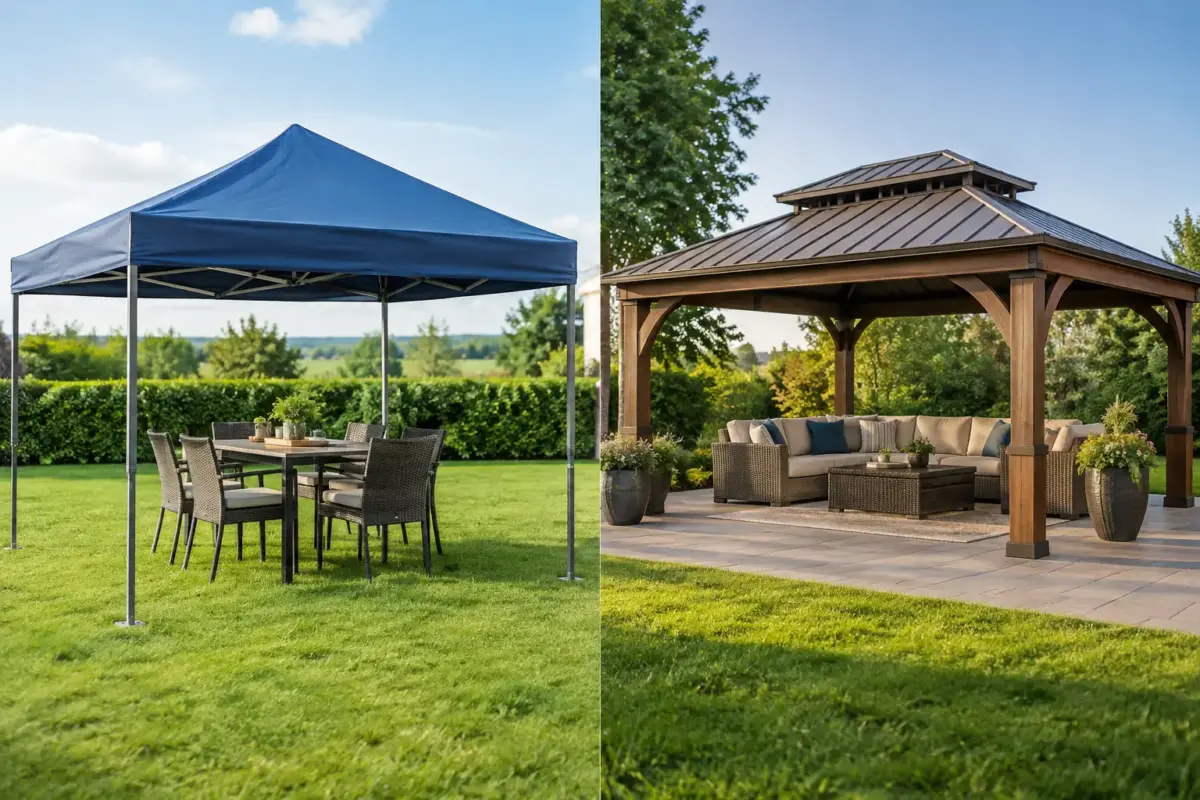
A pop up gazebo vs pavilion decision usually comes down to one practical question: do you need shelter that moves with your operation, or a structure that stays put? For market operators, sporting clubs, councils, trade teams and event marketers, choosing the wrong option can mean slow pack-downs, poor brand visibility or a costly structure that does not suit the site.
Both have a place. A pavilion can create an impressive long-term destination, while a heavy-duty pop-up gazebo gives you a professional, branded presence wherever the next event, activation or job takes you. The right answer depends on how often you move, what weather you face and whether your shelter needs to work as a serious brand asset.
Pop Up Gazebo vs Pavilion: The Practical Difference
A pop-up gazebo is a portable folding shelter. Its frame concertinas open, the roof attaches or remains fitted depending on the model, and it can be packed into a wheely bag for transport in a ute, van or trailer. Commercial-grade models are designed for frequent deployment at markets, community events, race days, outdoor exhibitions, school functions and mobile workplaces.
A pavilion is generally a fixed or semi-permanent shade structure. Think of a roofed structure installed in a park, hospitality venue, sports ground, school or backyard. It is usually larger, more architectural and intended to remain in one location. In some event settings, people also use “pavilion” to describe a large temporary event tent. Before comparing quotes, confirm which type is being discussed.
That distinction matters. A folding marquee is operational equipment. You transport it, erect it, brand it and reuse it. A permanent pavilion is site infrastructure. It requires a suitable location, ground preparation, approvals in some cases, installation and an ongoing commitment to that space.
When a Pop-Up Gazebo Is the Better Investment
Choose a pop-up gazebo when your location changes regularly or your team needs fast, repeatable setup. A well-built 3 x 3 m gazebo can become the front line of your business at weekend markets, product demonstrations, charity events and sporting fixtures, then be packed away after the day is done.
Speed is a major advantage. Folding frames are made to deploy without a toolbox, excavation or specialist installers. This is particularly useful for organisations running multiple events across the season. A club can use the same branded gazebo for registrations, merchandise and first aid. A council team can use it for outreach programs in different suburbs. A trade business can create a sheltered display area at field days without committing to a permanent build.
Portability does not have to mean lightweight or disposable. The frame grade makes the difference. Commercial aluminium and steel frames with reinforced connectors, substantial leg profiles and quality canopy fabric are built for recurring use, not one sunny weekend. Look beyond a low entry price and inspect how the structure is engineered, what tie-down gear is included and whether replacement parts are available.
A portable gazebo also gives marketing teams more value from a single purchase. Custom-printed roofs and walls put your logo, colours and key messages at eye level in busy outdoor environments. Instead of arriving under a generic white tent, your crew arrives under a recognisable branded structure that helps customers find you.
Where a Pavilion Has the Advantage
A pavilion is the stronger choice when shade is needed in the same place every day. For a school lunch area, a public reserve, an outdoor dining zone or a sports club spectator space, permanent shelter can deliver broad coverage with no daily bump-in or bump-out.
It also suits sites where the structure needs to feel integrated with surrounding buildings and landscaping. Posts, roofing materials, drainage and lighting can all be planned as part of a larger project. That level of finish is difficult to achieve with a portable structure, because a pop-up gazebo is designed to move rather than become part of the property.
The trade-off is flexibility. Once installed, a pavilion cannot be shifted to next month’s expo, taken to an away game or repositioned for a different event layout. Installation costs, permits, site access and engineering requirements can also substantially increase the total project cost. For organisations with one fixed venue and constant foot traffic, that may be money well spent. For an operator working across ten locations, it is often the wrong asset.
Wind, Weather and Safety Are Not Extras
Australian outdoor conditions can turn quickly. Heat, sudden rain and gusty winds place real demands on temporary shelter, particularly at exposed ovals, foreshore sites and open car parks. This is where frame strength and anchoring separate commercial gear from a basic backyard gazebo.
A quality pop-up structure should be specified with appropriate weights, pegs, straps and tie-down systems for the surface and conditions. Grass, asphalt, concrete and compacted dirt all require different approaches. Never assume a canopy is safe simply because it is open and looks stable. If wind conditions exceed the product’s operating guidance or event safety plan, pack it down.
Wind ratings must be read carefully too. They apply only to particular frame sizes, configurations and testing conditions, with the correct anchoring in place. Selected heavy-duty 3 x 3 m structures can be rated up to 100 km/h, but that does not mean every gazebo, every roof size or every site should be used in those conditions. A responsible supplier will help you match the frame and tie-down package to the job.
A permanent pavilion removes daily anchoring from the equation, but it still needs appropriate engineering for its location. Wind loads, drainage, corrosion exposure and footings are part of the build. Neither option is automatically safer. Safety comes from choosing equipment fit for purpose and using it correctly.
Branding: Mobile Billboard or Fixed Landmark?
For promotional work, a custom-printed pop-up gazebo is hard to beat. The roof is visible above a crowd, while printed walls can create a clear backdrop, weather protection and a more defined customer area. Add flags, table covers or a media wall and a standard event footprint becomes a branded activation space.
This matters when competitors are packed closely together. At a market or trade show, people often decide where to stop before they can read a brochure. Strong colour, clean graphics and a professional structure signal that your organisation is established and ready to do business.
A pavilion can become a local landmark, but its branding is normally less flexible. Signage may be installed permanently, yet it is tied to that one venue. If your brand needs to travel to regional shows, community festivals and client sites, portable printed shelter delivers far greater reach per use.
Compare the Full Cost, Not Just the Purchase Price
A cheap pop-up tent can look similar in a product image, then reveal its limits after a few wet pack-downs, rough transport runs or windy events. Bent legs, failed joints and unavailable spare parts quickly turn a bargain into waste. For professional users, a commercial frame, durable fabric and replaceable components are usually the better long-term calculation.
Likewise, a pavilion quote should be assessed as a project cost rather than a roof price. Include approvals, engineering, concrete, installation, drainage, electrical work and future maintenance. It can be a valuable capital improvement, but it is not a like-for-like substitute for portable event equipment.
If you need occasional fixed shade and regular mobile shelter, the best solution may be both. A semi-permanent pergola or pavilion can serve your home base, while a branded folding gazebo supports the events that happen beyond it.
Make the Choice Around Your Operating Reality
Start with how the shelter will be used over the next 12 months. If it needs to travel, set up fast, carry your branding and earn its keep across repeated events, a heavy-duty pop-up gazebo is the practical choice. Select the size around your footprint, then choose a frame class and anchoring system that suit the conditions you actually work in.
If the shelter will stay in one high-use location for years and needs to cover a larger permanent area, investigate a pavilion with the proper site and engineering advice. Do not buy a fixed structure to solve a mobile problem, and do not rely on a light recreational gazebo for commercial outdoor work.
Mountain Shade can help turn the portable option into a purpose-built event package, from commercial frames and printed canopies to walls, weights and transport gear. Start with the site, the weather exposure and the number of times you will use it, then choose shelter that keeps working long after the event is over.
