
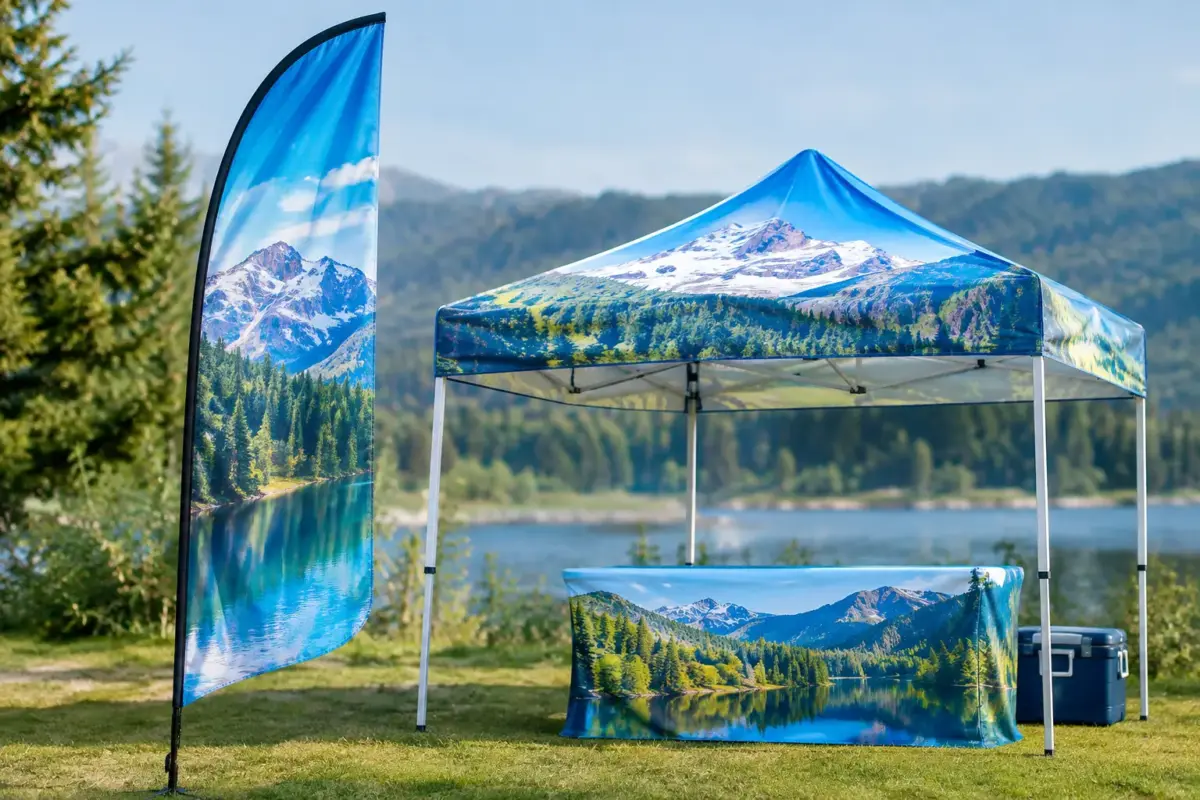
A printed marquee that looks sharp at its first event but fades, cracks or peels after a season is not a brand asset – it is a recurring replacement cost. The real dye sublimation benefits come from putting colour into the fabric itself, giving businesses, clubs and event teams a high-impact finish made for repeated outdoor use.
For organisations that work markets, sporting carnivals, trade events, community days and roadside activations, that matters. Your shelter or display has to attract attention from a distance, look professional up close and keep performing after packing, transport and exposure to Australian conditions.
What dye sublimation printing actually does
Dye sublimation is a fabric-printing process used on polyester materials. Artwork is first printed onto transfer paper with specialist inks. Under controlled heat and pressure, the ink converts to gas and bonds with the polyester fibres. Once the fabric cools, the colour becomes part of the material rather than sitting as a layer on top.
That difference is easy to see in use. With surface-applied print methods, ink or film can feel raised, stiff or prone to wear at folds and high-contact areas. A dye-sublimated marquee roof, wall, flag or table cover remains soft, flexible and consistent across the printed area.
It is not a universal print solution. Dye sublimation needs polyester or polyester-coated fabric, so it is not the right process for cotton canvas or every natural-fibre material. For custom outdoor display products built around premium polyester fabrics, however, it delivers a combination of colour, detail and durability that is difficult to beat.
Dye sublimation benefits for marquees and displays
Colour that carries across a busy site
Outdoor branding has seconds to do its job. Whether your setup is beside a footpath, in a crowded exhibition hall or along a sporting field, strong colour gives people a reason to look twice.
Dye sublimation reproduces bold brand colours, tonal gradients, photographs and fine graphic elements with exceptional clarity. This gives design teams far more freedom than a limited-colour logo application. A roof can carry full-colour panels, a repeating pattern, sponsor artwork and messaging that continues cleanly onto walls, banners and flags.
Exact colour matching still depends on the supplied artwork, fabric and production profile. Screen colours can also look different from printed fabric in direct sunlight. Supplying clean, high-resolution files and approved brand colour references gives the production team the best starting point.
No peeling, cracking or heavy print feel
A folding marquee roof is handled constantly. It is opened, tensioned, packed away, loaded into a ute or van, then used again the following weekend. A print method that leaves a thick layer on the surface can eventually show stress along fold lines.
Because sublimated colour is dyed into the fabric, there is no separate printed layer to crack or peel. The finished textile retains its natural flexibility, which helps it pack down neatly and present well when it is erected. This is particularly valuable on full-print roofs and walls, where a large branded area needs to look clean from every angle.
The finish also feels professional up close. That is worth considering for customer-facing applications such as corporate activations, council programs, hospitality events, show stands and race-team pits. A premium structure deserves graphics that do not look like an afterthought.
Full coverage without compromising the design
The major visual advantage of dye sublimation is coverage. Instead of placing a logo in one corner, you can use the entire fabric panel as a brand canvas. Roof peaks, valances, side walls, back walls, table covers, media walls and feather flags can all work together as one recognisable setup.
This makes a practical difference at crowded events. A branded roof is visible above heads. A printed wall gives you a clean backdrop for staff, product displays and photos. Flags add height and movement. Together, they create a site that looks organised before a team member has even started a conversation.
For sponsors and partner organisations, full-colour print also allows hierarchy. Your own identity can lead, while supporting logos, event names or campaign messages are positioned where they can be seen without turning the structure into visual clutter.
Built for repeat use, not one-off exposure
One of the strongest dye sublimation benefits is value over time. A quality printed shelter can work across dozens of appearances: weekend markets, school events, regional shows, recruitment drives, fundraisers, trade displays and sporting fixtures. The cost is spread across every activation rather than tied to a single day.
Printed fabric still needs sensible care. Keep it dry before long-term storage, remove dirt and salt promptly, and avoid dragging panels across rough ground. Continuous extreme UV exposure will affect any coloured textile eventually, while wind, rain and site conditions can place real demands on both fabric and frame.
That is why print quality should be assessed alongside the whole product package. Commercial-grade frames, reinforced connectors, suitable roof fabric, wall attachment systems, wheely bags, pegs, weights and tie-downs all affect how reliably your branded setup performs. A premium print cannot compensate for a lightweight frame, just as a heavy-duty frame cannot make poor graphics look credible.
Detailed artwork that stays readable
Small text, QR codes, fine linework and photographic imagery are often difficult to reproduce on lower-quality promotional displays. Dye sublimation gives designers the ability to include detail, but readability still needs practical thinking.
For a marquee valance or feather flag, primary messaging should be large enough to read from the distance where customers will first see it. Save fine detail for walls, table covers and close-range displays. QR codes should be tested from a mobile before production, and important logos should have adequate clear space around them.
A free visual mock-up is useful here. It lets you check the logo scale, panel placement, colour balance and message hierarchy before production begins. It is far easier to adjust artwork on screen than to discover at an event that your key message sits behind a wall or is too small to read.
Where a sublimated print delivers the most value
Dye sublimation works especially well when your equipment must create an immediate branded footprint. Market operators can use a full-print gazebo to look established among rows of generic tents. Sports clubs can create a professional team base while giving sponsors genuine exposure. Councils and community organisations can take the same identifiable setup to multiple suburbs and programs.
For trade professionals, a printed marquee does more than offer shade. It establishes a recognisable site presence at field days, product demonstrations and client events. For race teams, branded walls and flags create a controlled pit area that photographs well and gives partners visibility all weekend.
The scale should suit the job. A 3 x 3 m marquee is a versatile option for compact event sites, sampling stations and market stalls. Larger structures create more usable shelter for registration desks, merchandise, hospitality or operational teams. If the setup will be used in exposed locations, select the frame class, anchoring and accessories for those conditions rather than choosing on print appearance alone.
Specify the print and structure together
The best buying decision starts with how and where the equipment will work. Consider the footprint you need, how many people or products sit beneath it, whether walls are required, how often it will travel and what weather exposure is realistic. Then build the branding around that structure.
For example, an event team running a roadshow may prioritise fast setup, a wheely bag and interchangeable printed walls for different campaigns. A club on open sporting grounds may place greater value on a commercial frame, proper tie-down equipment and a layout that gives sponsors strong visibility. A market business may need a bold roof, side-wall branding and a table cover that makes a compact stall look complete.
Wind ratings are equally important to interpret correctly. They apply to specific frame sizes, configurations and test conditions, and they rely on correct anchoring. Never treat a printed marquee as safe to leave erected in severe weather simply because the fabric and graphics are premium. Follow the supplied setup guidance, use suitable weights and tie-downs, and pack down when conditions demand it.
Mountain Shade pairs custom dye-sublimated print with heavy-duty display structures, practical accessory systems and design support, so the finished result is built to work hard rather than merely look good in a mock-up.
A great branded shelter should earn its space at every event: providing reliable cover for your team while making your organisation impossible to miss. Start with the conditions you face, choose a frame and anchoring system that suits them, then use full-colour fabric print to give the whole setup a presence people remember.
