
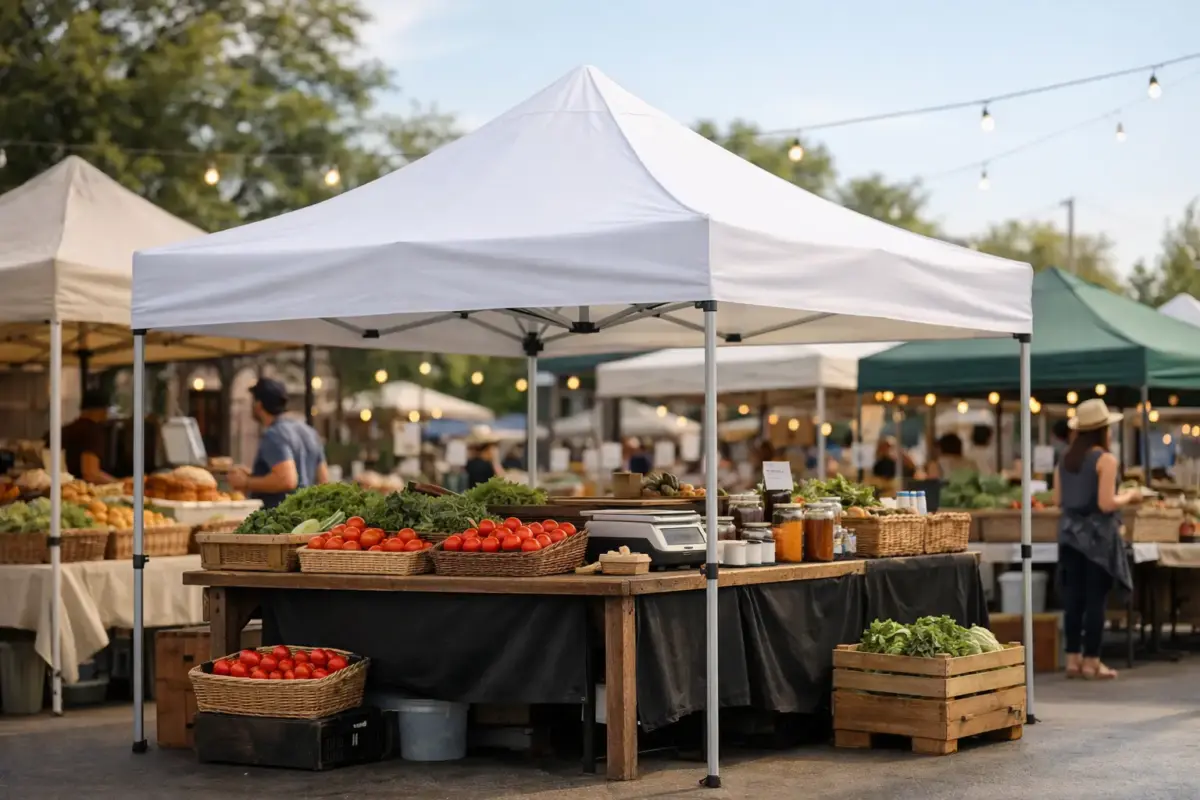
A busy market morning is not the time to discover that a bent leg, leaking roof or flimsy canopy has put your stall out of action. A commercial gazebo for markets needs to do more than create shade. It needs to protect stock, present your brand properly and keep performing through early starts, packed vehicles, rough ground and changing Australian weather.
For regular traders, a gazebo is working equipment. It is assembled, packed down, transported and exposed to sun, wind and rain more often than most event assets. Buying on price alone can look attractive for one or two weekends, but a commercial-grade structure earns its place over repeated market days.
What a commercial gazebo for markets must handle
Markets put pressure on every part of a folding marquee. Frames are opened and closed at speed. Feet land on uneven grass, bitumen and pavers. Roofs are exposed to UV, showers and wind gusts that can arrive without much warning. Then everything needs to fit back into the ute, van or boot without becoming a tangled pile of damaged gear.
The right setup starts with the conditions you actually trade in. A weekend craft stall under a covered city market has different needs from a food vendor on an open coastal foreshore, a produce operator at a regional showground or a brand activation team moving between events.
A commercial gazebo should give you confidence in four areas:
- A reinforced frame that will stand up to frequent opening, closing and transport.
- A waterproof, UV-resistant roof that keeps your trading space usable.
- Tie-down and weighting options suited to the site and weather conditions.
- Clear, high-impact branding that helps customers find you in a crowded market lane.
The frame is where the real value sits. Cheap structures often look acceptable when new, then develop loose joints, twisted legs and weak locking points after repeated use. Commercial aluminium or steel frames use stronger leg profiles, reinforced connectors and hardware designed for the work. That matters when you are setting up before sunrise and need every component to lock into place without a fight.
Choose the right size before adding the extras
A 3 x 3 m gazebo is the market standard for good reason. It gives most stallholders enough covered space for a front counter, stock display and room to serve customers, while remaining practical to transport and set up. It is also a common footprint for organised markets, although checking the site rules before ordering is always worthwhile.
If your display is compact, a smaller footprint can be easier to manage and may reduce site fees. If you sell bulky stock, run tastings, need food preparation space or share a site with another operator, a larger marquee or connected gazebo setup may be the better call. Bigger is not automatically better if it leaves you with too little room around your displays or creates a setup that your team cannot safely manage.
Think about the customer-facing edge too. A market gazebo should frame the stall, not hide it. A full front wall can be useful during rain or wind, but it can also make the space feel closed off. Many traders get better results with side walls for protection and an open front that keeps the counter visible. A half wall or awning can add a more defined service area without blocking the view of your products.
Frame grade matters more than a bargain bundle
A folding gazebo is only as dependable as its frame, joints and locking system. For regular markets, look beyond the canopy fabric and ask what is underneath it. Frame material, leg profile, wall thickness, connector construction and replacement-part availability all affect how long the unit will work for you.
Commercial-grade aluminium is popular because it delivers serious strength without turning every market run into a heavy lift. Steel can also be a strong option, particularly where weight is less of a concern. The best choice depends on how often you travel, who handles setup and the weather exposure at your usual sites.
Wind rating also needs context. A stated rating is useful, but it does not mean a gazebo can be left unsecured in high winds. Site conditions, ground type, wall configuration and correct tie-downs all change the load on a structure. Selected 3 x 3 m commercial structures can be rated up to 100 km/h when properly configured, but safe operation always means using the supplied or recommended anchoring equipment and making a sensible call when conditions deteriorate.
If a market organiser asks for weights, do not treat them as an optional add-on. Weight bags, steel base weights, pegs and tie-down straps are part of the structure’s safety system. The right combination depends on whether you are on grass, gravel, pavers or bitumen. Pegs may be effective on suitable turf, while weighted bases are essential where ground penetration is not allowed.
Make the roof work for your brand
At a market, your roof is often the first thing customers see. A plain canopy may provide shelter, but a custom-printed roof turns the same footprint into a visible business asset. Your name, logo, colours and key message can be recognised from across the market before customers reach your table.
Good gazebo branding is not about covering every panel with text. Keep the logo large enough to read at distance, use strong colour contrast and give customers one clear cue about what you sell. If your business name is unfamiliar, a short product descriptor can do more work than a crowded list of services.
Dye-sublimation printing is built into the fabric rather than applied as a surface layer, making it a strong option for long-term outdoor branding. It creates richer colour coverage and a professional finish that suits businesses trading every weekend, councils running community programs, sporting clubs and event teams that need equipment to look sharp across multiple locations.
Mountain Shade can provide free visual mock-ups before custom production, which helps you check logo scale, panel placement and colour balance before the marquee goes to print. That is particularly useful when several stakeholders need to approve the design or when you are matching existing flags, table covers and banners.
Do not overlook walls, bags and spare parts
The base gazebo is only one part of a dependable market setup. Side walls can reduce wind-driven rain, protect product displays and create a more controlled space for customers. They are especially useful for food, skincare, artwork, apparel and printed materials that should not be exposed to the elements.
A wheely bag protects the frame in transit and makes the walk from the car park to the site far easier. It also encourages better pack-down habits. When frames are thrown loose into a vehicle with tables, crates and signage, cosmetic damage quickly becomes bent components and damaged connectors.
Spare parts are another sign that you are buying commercial equipment rather than disposable merchandise. Roofs, walls, legs, connectors and tie-down gear eventually wear or go missing, especially across busy seasons. Being able to replace a component instead of replacing the entire gazebo protects your investment and keeps your branding consistent.
Build a market setup your team can repeat
The best market stall is not necessarily the most elaborate one. It is the one your team can set up safely, present consistently and pack down without losing time. Before your first trade day, run a full practice setup. Check the frame locks, fit each wall, test the weights and work out where signs, stock and EFTPOS equipment will sit.
Create a simple pack-down order as well. Remove stock first, dry the roof where possible, clean dirt from the feet and make sure no fabric is trapped in the frame before closing it. Folding a wet roof into a bag for days can lead to mould, odour and premature fabric wear.
A well-specified commercial gazebo gives your market business a reliable home base. Choose the frame for the conditions, anchor it properly, make the branding visible and invest in the accessories that keep the setup working week after week. When customers can spot you quickly and your stall is ready for whatever the forecast brings, you can focus on the part that matters: trading well.
