
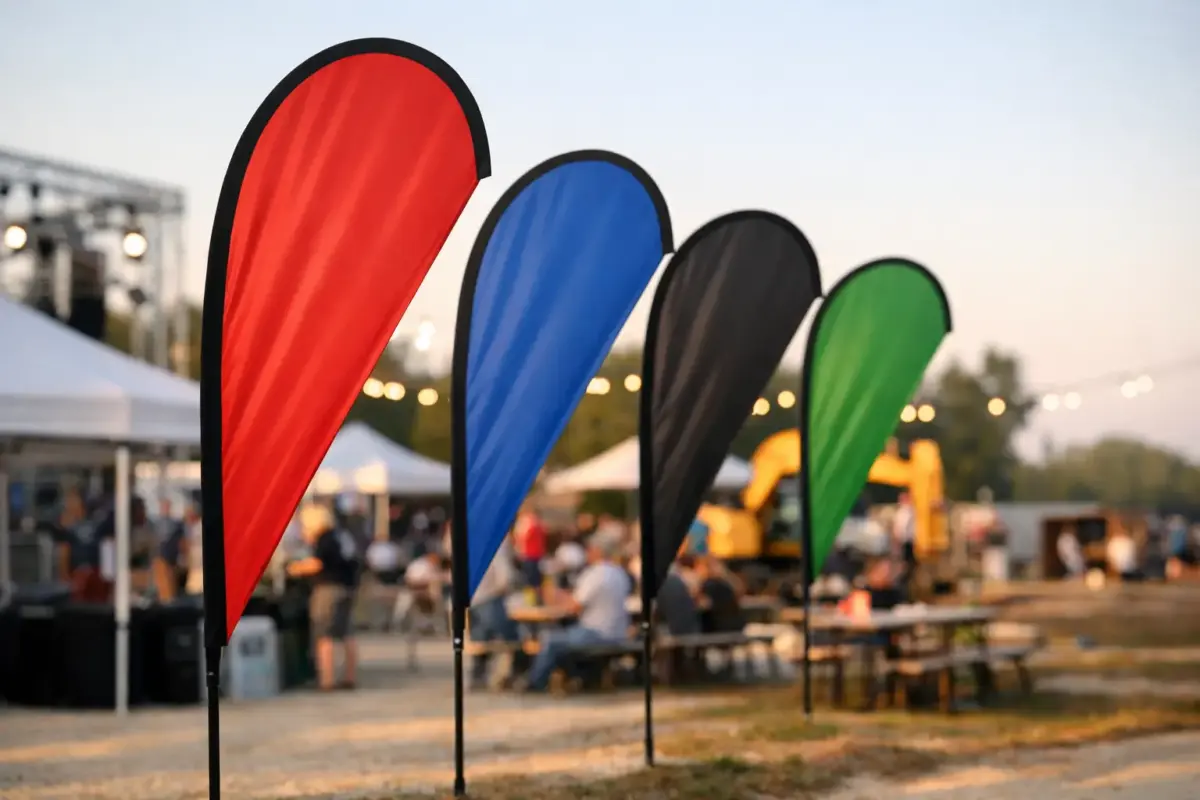
A busy market, race day or community event gives you seconds to be seen. Teardrop flags put your name, logo or campaign message above the crowd, creating a clear visual marker that keeps working while your team is serving customers, registering competitors or setting up the next activation.
Unlike fixed signage, a quality flag travels easily, sets up fast and can be repositioned as site conditions change. But not all flags are made for the same job. For Australian organisations that work outdoors regularly, the right flag system needs more than a bright print. It needs a stable base, a dependable pole, durable fabric and a design that can be read at a glance.
Why teardrop flags earn their place at events
The curved teardrop shape holds its form even when there is little wind. That is the main advantage over a traditional rectangular flag, which can hang flat and hide its message on still days. A teardrop flag stays taut around its pole, so your branding remains visible from the car park, across a sporting ground or along a crowded trade-show aisle.
They are also a practical way to claim space without building a large display. Position flags at entry points, beside a branded marquee, around a registration area or at the edge of a sales zone. A coordinated set creates a strong visual path that helps visitors find you before they need to ask.
For councils, schools and sporting clubs, flags can identify first aid, information, food areas, team zones and sponsor locations. For businesses, they work as portable signage for open days, product launches, roadside promotions and recurring market sites. The print does the brand-building, while the flag itself does the hard work of standing out.
Choosing teardrop flags for your site
Start with where the flag will be used, not just how it looks in a mock-up. A compact flag may suit a shopfront, expo booth or indoor display where ceiling height is limited. Larger flags make more sense for ovals, beachfront events, major activations and roadside sites where people need to spot your brand from further away.
Height affects both visibility and handling. Taller flags carry further over heads, vehicles and surrounding displays, but they also need more clearance and a stronger anchoring plan. If your event team is regularly working in tight market sites, a mix of sizes is often more useful than buying every flag at maximum height.
The base matters just as much as the flag. A ground spike is a straightforward option for grass, sand or soil. A cross base suits hard ground, indoor floors and paved areas, but it should be paired with a water bag or weight when conditions demand it. A heavy-duty flat base is useful where foot traffic is high and the surface must stay clear of pegs.
There is no universal base that suits every location. The smart approach is to select the pole and printed flag for your campaign, then match the base to each venue. That gives your team flexibility without compromising stability.
Wind is a safety decision, not a marketing claim
Flags are designed to move, but that does not mean they should stay deployed in every weather condition. Gusty weather puts extra load on poles, bases and fabric, particularly with taller flags or lightweight bases. A flag that starts walking across concrete is not just a damaged asset waiting to happen. It is a safety issue for staff and visitors.
Use sufficient weight for the surface, check that the pole sections are fully connected and keep an eye on changing conditions throughout the day. If strong winds arrive, pack the flags down. The same common-sense approach used for a heavy-duty gazebo should apply to every piece of event equipment around it.
Print that reads before people reach your stand
A teardrop flag is not a brochure. People rarely stand close enough to read paragraphs of copy, especially at a fast-moving event. The strongest designs use a large logo, high-contrast colours and a short message that can be recognised in a moment.
Think in terms of distance. Your organisation name, campaign word or directional instruction should be the hero. Fine print, long web addresses and multiple competing calls to action may be technically present, but they will not do much from 20 metres away. If the flag is used to direct people, a simple word such as ENTRY, INFO or REGISTRATION is usually more effective than a detailed explanation.
Custom dye-sublimation printing is the right choice when colour accuracy and all-over branding matter. The ink becomes part of the fabric rather than sitting on top of it, helping produce a clean, professional finish for repeat use. Artwork setup still matters. Low-resolution logos and poorly chosen colours cannot be rescued by printing alone, so use proper brand files and request a visual mock-up before production.
Double-sided visibility is another decision worth discussing early. In many applications, a single printed flag provides a clear reverse-side image that is adequate from both directions. Where exact readability and matching presentation on both sides are critical, a dedicated double-sided solution may be worth the extra investment. It depends on your artwork, viewing distance and how prominent the flag will be in the overall display.
Build a flag package, not a one-off purchase
One branded flag can make a point. Several flags used with purpose can transform a site. The most effective event setups treat flags as part of a complete presentation system alongside printed marquees, banners, table covers and media walls.
For example, a market operator might use two flags at the front corners of a gazebo to make a stall visible down the aisle. A race team can place flags at the paddock entrance, beside the pit area and near sponsor displays. A school running a carnival can use colour-coded flags to separate activities while retaining the same master brand across the site.
Consistency is what makes the investment work harder. Repeating the same colours, typeface and logo treatment helps people connect your shelter, signage and staff area as one professional operation. It also makes a modest footprint look more established than a collection of mismatched promotional items.
At Mountain Shade, custom flag packages can be planned around the way your organisation actually works, including suitable base options, artwork support and matching event structures. That is particularly valuable when multiple teams, venues or sponsor requirements are involved.
What heavy-duty use looks like in practice
Commercial event equipment is handled differently from a flag used once a year outside a retail shop. It gets loaded into utes, carried through car parks, packed down in a hurry and deployed across grass, bitumen, sand and indoor venues. Pole strength, fabric quality and hardware design all influence whether the system is still presentable after repeated use.
Look for a pole that assembles securely and a flag sleeve with neat, reinforced stitching. The fabric should be intended for outdoor display and the base connection should feel positive rather than loose or improvised. A carry bag is not a minor extra either. It protects the flag during transport, keeps components together and makes it less likely that an essential base or pole section disappears between events.
Replacement parts are worth considering before you buy. Accidents happen: poles get bent, bases are left behind and flags eventually reach the end of their working life. Choosing a supplier that can support spare parts lets you repair and refresh a proven setup instead of replacing the entire system.
Set up for visibility, then maintain for longevity
Before each event, inspect the pole sections, base fitting and flag sleeve. Assemble on a clean surface where possible, especially after wet or sandy events, and make sure the fabric is not twisted around the pole. Once raised, step back and check the flag from the direction visitors will approach. A flag hidden behind a van, tree or taller marquee has not failed – its placement has.
After use, let a wet flag dry before storing it for an extended period. Brush off dirt, sand and grass, then pack components into their bag without forcing the pole sections. Avoid leaving printed fabric exposed in the weather between events when it is not required. Sun, wind and grime all take their toll over time, and basic care protects both the colour and your investment.
The best teardrop flags are not decorative extras. They are hard-working brand markers that help people find you, trust your setup and remember who was behind the event. Choose the right height, base and print treatment, secure them properly, and put them where they can do their job long before the first customer reaches your stand.
