
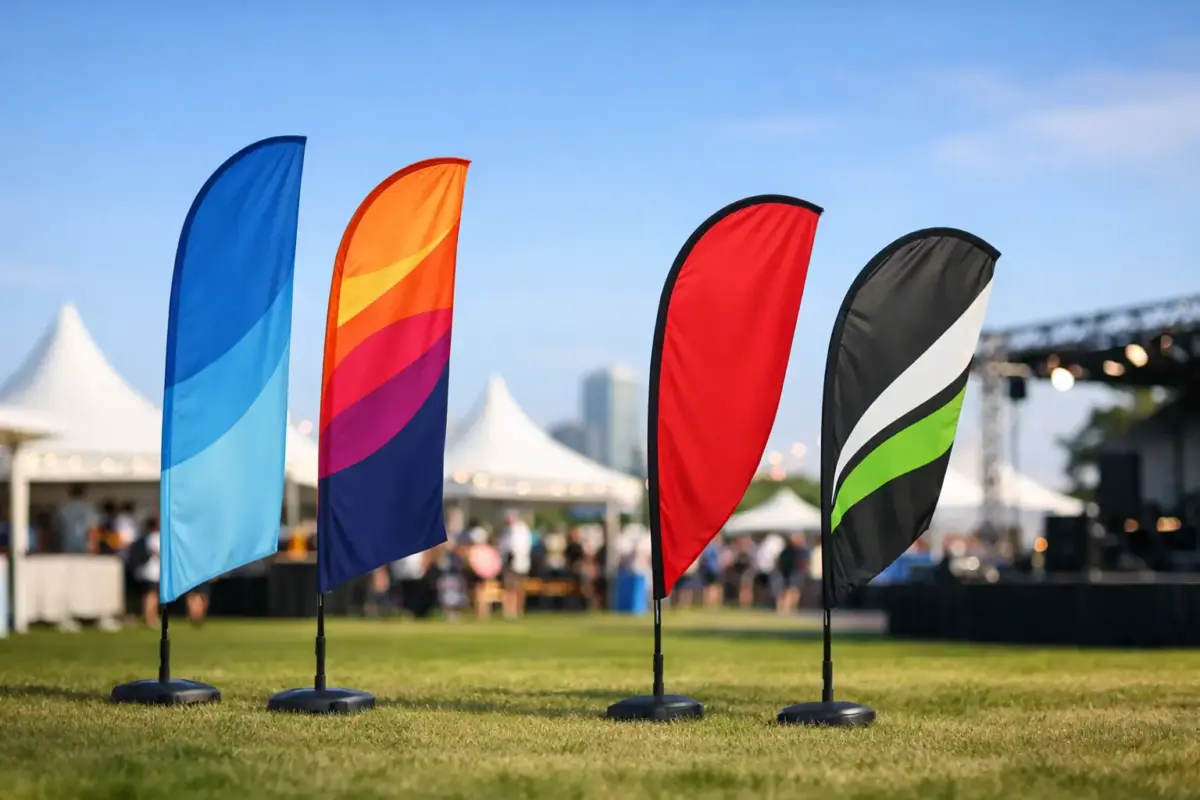
A busy event site gives people seconds to work out where to go, who is exhibiting and what deserves their attention. Event branding flags put your name, colours and message above the crowd without taking up valuable floor space under your marquee. Positioned properly, they turn a standard site into a professional, easy-to-find activation that keeps working from bump-in through to pack-down.
For markets, race days, trade shows, school carnivals, council events and sporting fixtures, a flag is not just decoration. It is directional signage, a brand marker and a visual cue that makes your team look organised. The right flag can be packed into a ute, set up quickly and reused across dozens of events. The wrong one can look faded, fall flat in still air or become a problem when weather turns.
Why event branding flags earn their space
A branded marquee gives you shelter and a large print area at ground level. Flags do a different job. Their height creates visibility over heads, vehicles, tents and trade displays, helping visitors spot your location well before they reach it. That matters when an event has long rows of similar stalls or several entrances.
They also make a site feel established. A single marquee can look functional. Add matching flags at the front corners, an entry point or along a queue line and the whole footprint has more authority. For a club, school or community programme, consistent branding helps volunteers and visitors find the right area. For a business, it gives a small activation the presence of a bigger campaign.
The return is strongest when flags are part of a repeatable event kit. Rather than ordering disposable signage for every activation, invest in quality printed fabric, durable poles and base options that suit the locations you actually use. A market operator on hardstand needs a different setup from a sporting club driving ground spikes into grass. Buying for the real conditions saves money and frustration later.
Choose the right flag shape for the job
Teardrop and feather flags are the two most common choices, but they create different results.
Teardrop flags for a consistently readable shape
Teardrop flags hold a defined shape because the curved top section keeps the fabric under tension. They are a strong choice where you need a logo, short message or sponsor mark to remain recognisable even when there is very little breeze. Their compact profile also works well near entries, footpaths and smaller retail-style displays where you do not want the flag to extend too far into the walkway.
Use a teardrop design when clarity is more valuable than fitting lots of information onto the fabric. A bold logo, simple icon, website address or three-word offer will read better than a crowded layout.
Feather flags for height and movement
Feather flags have a taller, narrower profile and more fabric area. They create movement in a breeze and are particularly effective for drawing attention along a road frontage, around a large outdoor venue or across an open sports ground. Their upright form makes them useful for repeated messages, such as registration, first aid, food vendors or team areas.
The trade-off is movement. In changing wind, the lower portion of a feather flag can move more than a teardrop, so fine print and dense information are harder to read. Keep the message direct and let the size, colour and logo do the heavy lifting.
Make the print visible before it goes to production
Great event branding flags are designed for the distance at which people will see them. Most visitors will first notice the flag from 10, 20 or 50 metres away, not from directly beside the base. If the key message cannot be understood from that distance, it is too small or too complicated.
Start with one priority: your brand name, a directional word, a sponsor logo or a clear offer. Place that priority high on the flag where it is least likely to be obscured by people, stock or furniture. Use strong contrast between the background and lettering. Dark type on a dark photo, pale type on a busy pattern and multiple competing logos all reduce impact.
Dye-sublimation printing is a practical choice for custom flags because colour is printed into the fabric rather than sitting as a surface layer. It produces sharp, full-colour artwork and allows the flag to look professional from both sides. However, readable design still matters more than adding every brand element available. A flag is a signal, not a brochure.
Before approving artwork, check four things:
- Is the logo large enough to identify at a glance?
- Does the main message work when viewed from a distance?
- Are the colours consistent with your marquee, table cover and other event assets?
- Has the layout accounted for the flag shape, pole sleeve and natural movement of the fabric?
A free visual mock-up is worth using, particularly when you are matching flags to a newly printed gazebo or producing a multi-site campaign. It is much easier to adjust scale, colours or placement on screen than after production.
Select a base for the surface and conditions
The pole and base system determine whether a flag is convenient equipment or a liability. There is no single best base because the right option depends on the ground, expected wind, flag size and whether vehicles can access the site.
A ground spike is a practical option for grass, dirt and other soft surfaces. It is quick to install and keeps the setup clean, but it needs firm ground and sufficient depth. A cross base suits indoor venues, concrete, pavers and compacted hardstand, especially when paired with a weight bag or solid weight. For more demanding outdoor sites, a heavy-duty base provides greater stability but adds weight to transport and setup.
Do not treat a base as an afterthought. A tall flag creates leverage, and stronger gusts can put significant load through the pole, bearing and base. Check event rules, assess the weather and use the appropriate weight for the conditions. If wind rises beyond what your setup can safely handle, lower or remove the flags. Good branding is never worth risking people, vehicles or neighbouring displays.
Build a complete event frontage
Flags work best when they have a clear role in a wider setup. Place two matching flags at the front corners of a branded marquee to frame the site. Use a third flag several metres away as a visual marker that draws people towards you. At a large event, directional flags can separate registration, merchandise, food service and information points without cluttering the shelter itself.
Avoid placing flags where they block sightlines, pinch pedestrian access or create a trip hazard around the base. Keep them outside queues where practical, and allow for fabric movement in windy conditions. At vehicle-based events, position flags so drivers can see them without them sitting too close to traffic lanes.
Matching the flag artwork to your roof, walls, banners and table covers matters. It does not mean every item needs the same full design. In fact, flags are often stronger when they carry a simplified logo or message while the marquee holds more detailed graphics. The shared colour palette and type treatment do the work of tying everything together.
Buy for repeat use, not one good photo
Cheap flags can be tempting for a one-off event, but frequent exhibitors quickly notice the difference in fabric quality, pole strength, stitching and hardware. Australian conditions can be rough on display equipment: UV exposure, coastal air, dust, hard ground and sudden weather changes all test the gear. A commercial-grade setup should be chosen with transport, storage and replacement parts in mind.
Look for poles that break down into manageable sections, reliable connectors and a carry bag that keeps components together. Inspect fabric and stitching after events, particularly around the pole sleeve and lower edge. Let flags dry before storage if they have been exposed to rain, and avoid packing wet fabric away for long periods. Replacing a worn print skin while retaining serviceable hardware can also be more economical than replacing the whole system.
For organisations running regular activations, standardising on a few flag sizes and base types makes setup easier for staff and volunteers. It reduces missing parts, speeds up packing and creates a more consistent look across every location. Mountain Shade can help match printed flags, heavy-duty marquees and accessory systems into a package built around how your team actually operates.
The most effective flag setup is the one your crew can deploy confidently, secure correctly and use again next weekend. Keep the message bold, choose hardware for the site and treat every flag as a working part of your event infrastructure.
