
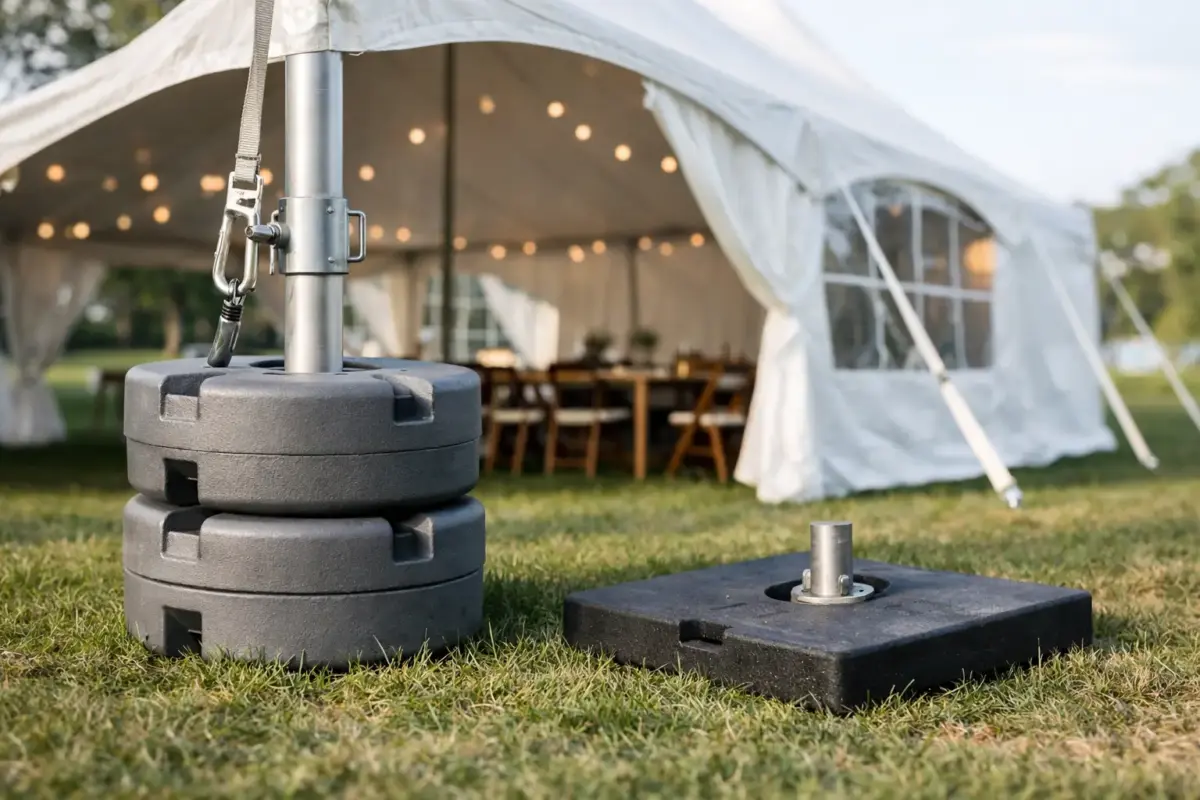
A great marquee can carry your branding across a busy market, race day or community event. But marquee weights are what help keep that structure where it belongs when the weather turns, crowds move through and the ground will not take a peg. They are not an optional add-on or a last-minute safety fix. They are part of the system that protects your people, your equipment and your professional reputation.
For Australian operators, this matters. A calm morning can become a gusty afternoon quickly, particularly on exposed ovals, coastal sites, car parks and showgrounds. The right frame, roof, tie-downs and weights work together to create a more secure setup. Get one part wrong and even a premium shelter is being asked to do more than it should.
Why marquee weights are a commercial essential
Weights add downward force at the legs of a gazebo or folding marquee. Their job is simple: reduce the risk of the structure shifting, lifting or walking across hard ground. In practice, choosing them properly requires more thought than grabbing four light sandbags from the ute.
A marquee behaves differently depending on its size, frame grade, roof shape, side walls, location and the direction of the wind. A 3 x 3 m promotional gazebo at a sheltered school fete does not face the same forces as a larger shelter on an exposed sporting field. Add printed walls, awnings or banners and you create more surface area for wind to push against.
That is why commercial event equipment should be treated as operational infrastructure. Your branding needs to stand out, but your setup also needs to perform. A weighted marquee looks organised and capable. An unsecured one looks like a hazard waiting to happen.
Start with the site, not the weight bag
Before selecting a weight system, look at the site conditions and event requirements. The surface is the first decision point. On grass or soil, quality pegs and tie-down straps may be suitable when the ground is firm and the venue permits staking. On concrete, asphalt, pavers, indoor exhibition floors or synthetic turf, pegs are usually not an option. Weights become essential.
Then assess exposure. Consider nearby buildings, trees and grandstands, but do not assume they make a site safe. Wind can funnel between structures, roll over roofs and hit a marquee from an unexpected angle. A site that feels protected at ground level may still produce sharp gusts at canopy height.
The setup itself also changes the requirement. Side walls improve shelter and create a more enclosed customer space, but they catch wind. An awning gives you extra covered area, yet it adds leverage to the frame. A flag or banner positioned close to the marquee should be independently secured rather than relying on the gazebo structure.
Finally, check the event organiser’s conditions. Councils, schools, race venues and major event sites may specify a minimum weight per leg. Those rules are a baseline for access to the site, not a substitute for sound judgement on the day.
How much weight does a marquee need?
There is no responsible one-number answer. The correct amount of weight depends on the marquee footprint, frame construction, whether it is pegged or tied down, the surface and the forecast conditions. Larger canopies and structures carrying walls or awnings need more restraint than a small open-sided setup in a protected area.
The most reliable approach is to apply weight at every leg, distribute it evenly and combine it with the appropriate tie-down method where the surface allows. Do not concentrate all the weight on the windward side and leave other legs unsupported. A marquee needs balanced restraint, because wind direction can change without warning.
Frame quality matters here too. Heavy-duty commercial frames with reinforced connectors, solid leg profiles and engineered joints provide a stronger foundation for the canopy. They are not, however, permission to ignore ballast. Even selected structures with stated wind ratings must be installed according to their specifications and secured with the correct equipment. Wind ratings are conditional performance information, not a guarantee that a structure can remain open in every weather event.
If conditions escalate beyond what your setup, site or venue approval can safely handle, pack down. There is no prize for staying open through unsafe weather.
Choosing the right type of marquee weight
The best weight is one that suits the way you work. For regular events, purpose-built stackable or leg-mounted weights are usually the cleanest commercial option. They sit close to the leg, keep the load low and make it easier to create a tidy public-facing site. They also transport more predictably than improvised ballast.
Weight bags can be practical for operators who need to reduce transport weight before arriving on site. Fillable bags may be useful where water or sand is readily available, but they need to be durable, properly filled and firmly attached. A loosely filled bag is not the same as a rated, stable ballast system.
Concrete blocks, buckets and random site materials are poor substitutes. They can chip, crack, leak, create trip hazards or shift under load. More importantly, they rarely attach securely to the marquee leg. Equipment that merely sits nearby is not necessarily restraining the frame.
For recurring activations, think about handling as well as kilograms. The heaviest option is not automatically the smartest if your team has to move it across a car park, up stairs or in and out of a trailer every weekend. A modular system lets you build the required load per leg while keeping individual pieces manageable. It is safer for staff and faster to deploy.
Attach weights properly at every leg
A weight only works as intended when it is positioned and secured correctly. Keep it low at the base of the leg wherever possible. Avoid hanging heavy objects high on the frame, as this can increase movement and place force where it does not belong.
Purpose-designed weights should fit the leg or be fixed using the supplied attachment method. Check that straps, brackets, pins and buckles are in good condition before each event. If a strap is frayed or a fastening is bent, replace it. Spare parts are far cheaper than an interrupted event or damaged frame.
Once the marquee is weighted, complete a walk-around before opening to the public. Confirm each leg is locked, the roof is tensioned correctly, walls are fitted as intended and no weight can be kicked, rolled or moved by customers. Keep weights clear of entry points and manage any exposed bases where foot traffic is heavy.
This inspection should be repeated after a weather change, after moving a wall or awning, and whenever the site becomes crowded. Outdoor setups are not set-and-forget.
Weights work best with a complete tie-down plan
Weights are one part of a restraint system, not the whole plan. Where the ground permits it, use suitable pegs and tie-down straps in addition to leg weights. On hard surfaces, use a correctly sized ballast system at each leg and review the setup more frequently. The aim is to resist both uplift and sideways movement.
Pay close attention to the roofline. A properly tensioned canopy sheds water better and reduces flap, while loose fabric can catch gusts and transfer unnecessary movement into the frame. Clear pooled water promptly and never allow a roof to sag under a load.
If you operate multiple structures, avoid joining them together and assuming the combined setup is automatically safer. Joined marquees need a deliberate plan for each frame, each leg and each exposed edge. One poorly secured unit can affect the entire row.
Common mistakes that create avoidable risk
The first mistake is underweighting a marquee because the weather looks fine at setup. Conditions can change quickly, and an open area offers little warning. The second is treating all marquees as equal. A lightweight promotional frame, a heavy-duty commercial gazebo and a larger folding structure require different thinking.
Another issue is adding walls late in the day without reassessing the restraint. That extra printed panel may improve visibility and shelter, but it also changes wind loading. The same applies to awnings, flags and display stock stored under the canopy.
Finally, do not leave pack-down too late. If gusts are building, staff should have a clear decision-maker and a practical plan to remove walls, lower the structure or close it safely. Strong equipment gives you more confidence, not an excuse to take risks.
Build a setup that looks as strong as it performs
Your event shelter is often the first thing customers, members or visitors see. It should present a sharp printed roof, clean walls and a stable, professional footprint from every angle. Mountain Shade can help match heavy-duty frames, branded canopy options and accessory systems to the way your organisation operates – from markets and trade displays to sporting clubs, council programs and regional events.
Choose marquee weights as carefully as you choose your frame. A properly secured setup lets your team focus on the job in front of them: serving customers, promoting your organisation and making a strong impression outdoors.
