
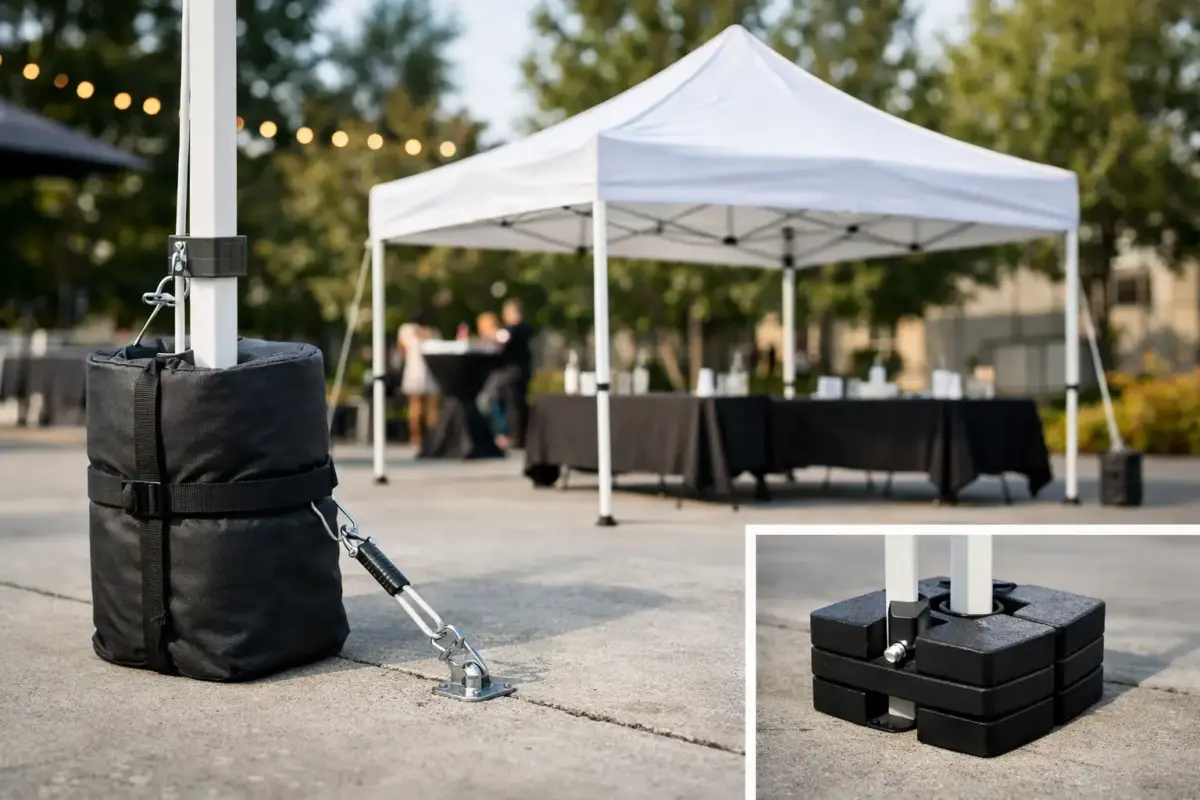
A concrete forecourt looks like the easy option until a gust hits a raised gazebo roof. Without grass to peg into, the frame, roof and branding become a large wind-catching surface – and a loose marquee can quickly become a safety issue for staff, customers, vehicles and neighbouring stalls. Knowing how to secure gazebo on concrete means choosing a system that suits the site, the frame and the conditions, not simply placing a couple of light weights on the feet.
For markets, sporting days, council activations and trade displays, the goal is straightforward: keep every leg restrained, prevent movement in changing wind, and pack down with no damage to the slab or venue. The right approach is usually a combination of purpose-built leg weights, ratchet tie-downs and approved fixing points where the site allows them.
Start with the gazebo, surface and weather forecast
A heavy-duty commercial gazebo gives you a stronger starting point than a lightweight backyard frame, but no pop-up structure is safe to leave unsecured. Wind ratings apply only when the structure is correctly assembled, weighted and tied down according to the manufacturer’s instructions. They are not a reason to operate through severe weather or ignore a site-specific risk assessment.
Before setup, inspect the concrete. Is it a smooth public plaza, a rough carpark, a loading bay or a slab with existing eye bolts? Check for slopes, cracks, drains, expansion joints and vehicle access. A leg positioned beside a drain or on an uneven joint may not sit flat, even if the rest of the gazebo appears level.
Then assess exposure. An open oval, waterfront, street corner and elevated shopping-centre carpark can funnel wind far more aggressively than a sheltered school courtyard. Rain matters too. Wet concrete can reduce grip under feet and make loose ropes more hazardous around pedestrian areas.
If strong gusts, thunderstorms or damaging winds are forecast, the right decision may be to delay setup, remove sidewalls, lower the structure or pack it down completely. A marquee is valuable operational equipment and a highly visible brand asset, but it is never worth risking people or property.
How to secure a gazebo on concrete with ballast
For most temporary event sites, purpose-built ballast is the practical answer. Ballast adds downward force at each leg, reducing the chance of the gazebo sliding, lifting or walking across the concrete. It must be distributed evenly, secured to the frame and matched to the expected conditions.
Purpose-made marquee weights are better than improvised options because they sit low, fit the leg profile and can be attached securely. Sandbags can work when they are heavy-duty, fully filled and designed with fixing straps, but loose bags, buckets, milk crates and random pavers are poor substitutes. They can shift, split, create trip hazards or damage the slab.
As a baseline, weight every leg. Do not load only the windward side, even if that is where the gusts are coming from. Wind direction changes, and an unevenly weighted gazebo can twist the frame or place excessive pressure on individual connectors.
The exact ballast requirement depends on several variables: gazebo footprint and roof height, frame grade, sidewalls, awnings, signage, site exposure and the manufacturer’s stated setup requirements. A 3 x 3 m commercial pop-up with an open roof in a sheltered market lane is a different job from a 6 x 3 m gazebo fitted with printed walls on an exposed concrete concourse.
Use the manufacturer’s specifications as the minimum standard, then increase restraint where the site demands it. Bigger roofs, walls and awnings create more sail area. This improves shelter and visual impact, but it also increases wind load. If your event setup includes flags, banners or an attached awning, treat the whole display as one wind-management system.
Attach weights to the frame, not just beside it
A weight sitting against a foot is not necessarily securing the gazebo. It may stop minor movement, but it can separate from the leg under lift or sideways force. Secure weights directly to each leg with the supplied brackets, straps or locking mechanism.
Keep the ballast low and tidy. The best setup protects the public circulation area rather than filling it with loose straps, protruding handles and awkward obstacles. In busy markets and community events, staff should be able to see every leg and check every connection quickly.
Add tie-downs where approved anchor points exist
Ballast is often enough for lower-exposure temporary setups when used to specification. However, tie-downs provide a stronger level of restraint when the site has approved anchors or solid fixing opportunities. They reduce uplift and lateral movement by transferring force away from the frame legs.
Use ratchet straps or rated tie-downs attached to the gazebo’s designated anchor points. Run them at an outward angle to fixed, approved anchors such as installed eye bolts, engineered ground anchors or venue-approved structural points. Do not tie off to handrails, temporary fencing, park benches, light poles, trees, vehicles or anything not explicitly approved for the load.
A ratchet strap should be firm, not wildly over-tightened. Excess tension can distort the frame, damage roof fabric and make the gazebo harder to square. Once the structure is fully opened and the roof is tensioned correctly, tighten each tie-down evenly and recheck the legs remain vertical.
Where straps cross a public area, use a proper cable cover or reposition the gazebo. A secure structure should not create a new trip hazard. This is especially important for council events, school functions and any activation with high foot traffic.
Drilling into concrete is a venue decision, not a quick fix
Permanent or semi-permanent installations may use mechanical anchors or chemical anchors fixed into concrete. This can be an excellent solution for a gazebo that will remain in one location, but it is not suitable for a standard one-day event without written approval and the right installation process.
Drilling a slab can damage waterproofing, reinforcement, underground services or the venue’s finish. It may also breach a hire agreement, council condition or body corporate rule. For public and commercial sites, anchor design should be assessed by a qualified installer or engineer, particularly where the structure is large, enclosed or regularly exposed to wind.
Never drill through a gazebo foot and assume the job is done. The anchor type, embedment depth, slab thickness, edge distance and frame connection all affect holding strength. A strong bolt in weak or cracked concrete is not a reliable restraint system.
Set up in the right order
Good anchoring starts before the roof goes up. Build the gazebo on the flattest available section of concrete, clear of vehicle paths and doors that may open into the structure. Position the branded face towards customer traffic, but do not sacrifice safety for the best visual angle.
Follow this sequence:
- Open and square the frame, ensuring every leg locks correctly.
- Fit the roof and raise the gazebo to its intended height.
- Attach approved ballast to every leg before adding walls, awnings or signage.
- Install tie-downs to approved anchor points, then tension them evenly.
- Fit sidewalls only when conditions allow, and reassess the ballast and straps once they are on.
- Check the setup again after 10 to 15 minutes, then at regular intervals throughout the event.
This order matters because walls and accessories change the wind load after the initial setup. A gazebo that felt stable with an open roof may need more restraint once you enclose one side for weather protection or privacy.
Avoid the shortcuts that cause problems
The most common failure is underweighting. The second is assuming a heavy frame alone will stay put. Commercial aluminium and steel frames are designed for repeated use and stronger performance, but they still need correctly matched restraint.
Avoid tying ropes to loose objects, leaving legs unweighted while waiting for the event to start, or using water containers that are not properly sealed and secured. Do not rely on staff standing on a foot plate during gusts. That puts people in danger and does nothing to create a dependable, repeatable setup.
Also watch roof tension. A sagging canopy can collect water, add unexpected weight and place stress on the frame. Keep the roof tight, clear pooled water promptly and stop using the gazebo if any leg, truss, connector or strap shows damage.
For teams running frequent events, standardising the kit saves time and removes guesswork. A commercial gazebo package with correctly sized weights, rated tie-downs, spare parts and a wheely bag makes setup faster across markets, race days, trade shows and regional activations. Mountain Shade can help match a heavy-duty frame and accessory package to the way your organisation actually operates.
The strongest concrete setup is the one your crew can repeat correctly under pressure: every leg weighted, every approved tie-down tensioned, every weather change monitored, and a clear plan to lower or pack down before conditions become unsafe.
