
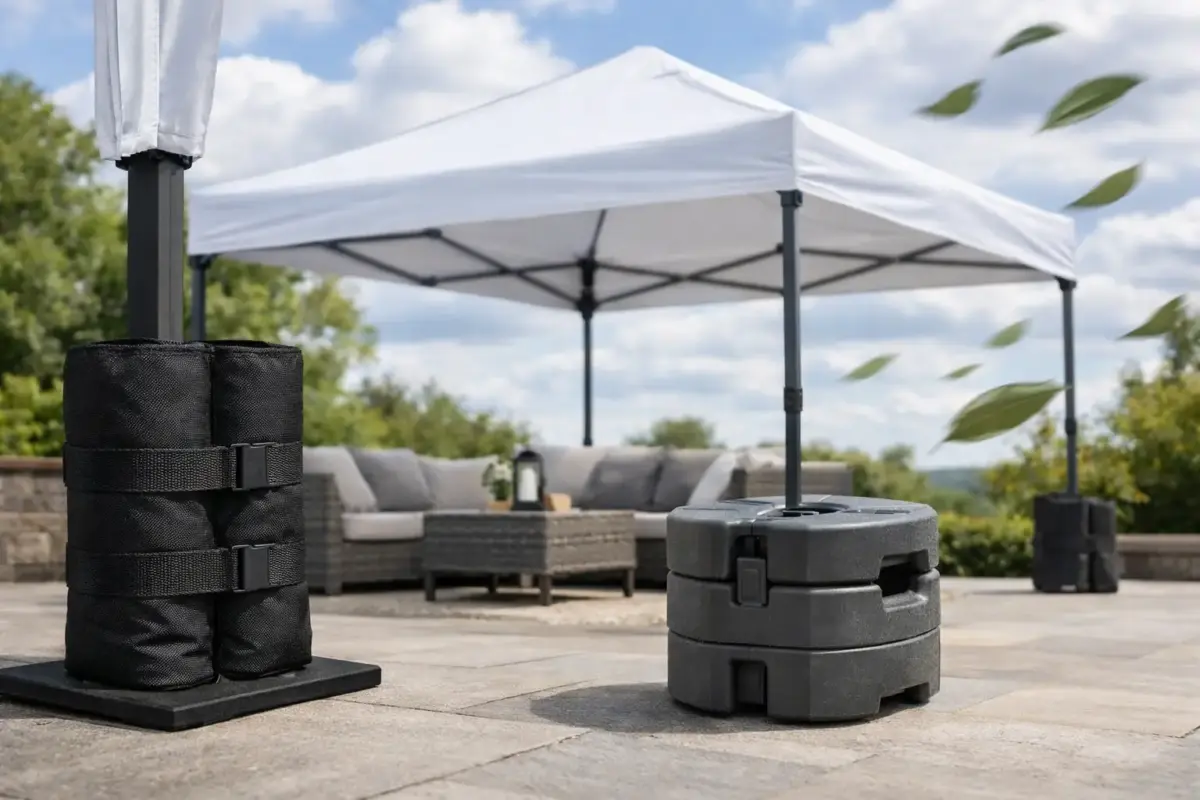
A gazebo can look solid right up until a gust gets underneath the roof. That is why understanding gazebo weights required for wind is not a minor accessory decision. For market operators, sporting clubs, councils and event teams, correctly securing every leg protects people, stock, signage and the commercial-grade frame you rely on event after event.
There is no responsible one-number answer for every site. A 3 x 3 m marquee on grass at a weekend market faces a completely different risk to a branded gazebo set up on exposed concrete at a coastal activation. Wind speed, surface type, gazebo size, frame rating, roof configuration and local site conditions all change the anchoring requirement.
Why gazebo weights required for wind change by site
Wind does not simply push against the side of a gazebo. It also moves across the roof and can create uplift, pulling the structure up before it pushes it sideways. Once a leg lifts or skids, the load transfers quickly through the frame. A gust can then turn an otherwise stable marquee into a moving hazard.
The risk rises sharply as wind speed increases. Wind force does not increase in a neat, straight line. A small increase in wind speed can create a much larger increase in pressure on the canopy. That is why a gazebo that appears fine in a light breeze can become unsafe when an afternoon front rolls through.
Your setup also matters. A fully walled gazebo catches far more wind than an open shelter. A roof with awnings, flag poles, banners or other accessories has a larger wind profile. Hard surfaces such as bitumen, concrete and pavers remove the option of pegging directly into the ground, placing more reliance on properly sized leg weights and engineered tie-downs.
Start with the manufacturer’s wind rating
A wind rating is useful only when you understand the conditions behind it. It is typically based on a specific frame, roof, anchoring arrangement and controlled testing or stated setup conditions. It is not permission to leave a gazebo open in any weather, or to assume that a lighter frame with a few sandbags will perform like a heavy-duty commercial system.
Selected Mountain Shade 3 x 3 m structures are rated for winds up to 100 km/h when set up in accordance with the relevant product requirements. That performance comes from the complete system: reinforced frame engineering, quality connectors, correctly fitted canopy and suitable securing equipment. It should never be treated as a substitute for active weather monitoring and sensible pack-down decisions.
Before each event, confirm the rated wind capacity of your exact frame and roof. Check whether the rating requires peg straps, weight plates, ratchet straps or a combination of these. If the supplier has specified a minimum weight per leg, that figure is the starting point, not a suggestion to reduce when the site looks calm.
A practical guide to gazebo weight per leg
For routine outdoor use, weight should be distributed evenly across all legs. Avoid the common shortcut of placing several heavy bags on one side and assuming the structure is secured. Wind is unpredictable, changes direction and can lift the opposite corner first.
As a broad planning guide, many operators use at least 15 kg per leg for low-wind, short-duration setups in sheltered conditions. For typical outdoor trading, sporting and promotional environments, 20 to 30 kg per leg is a more realistic working range when weight is the primary anchoring method. Exposed sites, larger marquees, roof-only setups facing gusts, and sites with walls or branding accessories may require 30 kg to 40 kg or more per leg, alongside tie-down straps.
These are planning ranges, not a replacement for the gazebo manufacturer’s instructions, venue rules or a weather-based risk assessment. If the specified anchoring requirement exceeds what your weights can provide, you need more anchoring, a different site position or a decision not to erect.
A 3 x 6 m gazebo, for example, has a substantially larger roof area than a 3 x 3 m model. It has more legs, but it also presents more canopy to moving air. Do not assume that using the same weight per leg automatically delivers the same level of safety. Frame class and approved tie-down points matter just as much.
Weights, pegs and straps work best as a system
On grass or compacted soil, weights alone are rarely the strongest option. Purpose-made pegs driven to the appropriate depth, combined with straps from the gazebo’s approved anchor points, provide resistance against both sliding and uplift. Leg weights then add valuable stability at ground level.
On concrete, indoor-outdoor plazas or bitumen, use properly designed gazebo weights that fit securely around or attach to the leg. Loose objects, random boxes, bottles filled with water and improvised gym weights are unreliable. They can shift, crack, become trip hazards or fail to keep the load centred at the base of the leg.
For dependable outdoor anchoring, assess these four elements together:
- the manufacturer-approved anchor points and tie-down method
- the weight placed at every gazebo leg
- the ground surface and whether pegs can be used safely
- the expected wind, gusts, storms and changing weather during the event
Ratchet straps can offer greater tension and control than loose ropes, but they must be installed correctly and kept clear of public walkways. In busy event environments, use visible straps, protect pedestrian routes and make the setup part of the site safety plan.
Walls can turn a safe gazebo into a sail
Sidewalls are valuable for rain protection, privacy and branding, but they require extra caution. A single wall can channel wind through the structure. Multiple walls can trap wind. A fully enclosed marquee has a much larger surface area for gusts to strike.
If winds rise, removing walls is often the first sensible adjustment, provided it can be done safely. Do not wait until the roof is shaking, legs are lifting or a wall is already under heavy pressure. At that point, attempting to remove accessories may expose staff to greater risk.
The same applies to printed flags, awnings and banner attachments. They improve visual impact, but each addition changes the overall wind loading. For a branded activation, plan the shelter and signage as one site system rather than treating each item as separate equipment.
Know when more weight is not enough
There is a point where adding further weight does not make continued operation safe. Severe gusts, thunderstorms, lightning, saturated ground, loose pegs or a forecast wind change are reasons to stop trading, clear the area and pack down when it is safe to do so.
Never leave a gazebo erected and unattended, particularly overnight. Weather can change rapidly across Australian event sites, and an empty setup still creates a risk to nearby vehicles, neighbouring stalls and public infrastructure. Lowering the canopy height does not eliminate the need for proper anchoring either.
Event managers should nominate who is responsible for checking forecasts, monitoring on-site conditions and authorising pack-down. This is especially useful for schools, clubs and councils where volunteers may be setting up equipment without the same experience as a regular market operator.
Choose equipment built for repeat outdoor use
A lightweight promotional tent may suit a calm, indoor-adjacent display, but it is not the right tool for every outdoor job. If your organisation attends regional shows, race days, weekend markets, coastal events or multi-day sporting fixtures, frame grade and accessory compatibility deserve serious attention.
A heavy-duty gazebo with reinforced legs, quality roof fabric, replacement-part availability and matched weights, pegs and tie-downs is a long-term infrastructure investment. It protects your team and creates a better platform for branded roofs, walls and signage that need to keep looking sharp after repeated use.
The right anchoring setup gives your gazebo the best chance of performing when conditions are workable. The smarter call, however, is always to respect the weather early – because the strongest event setup is the one your team can pack down safely before the wind makes the decision for you.
