
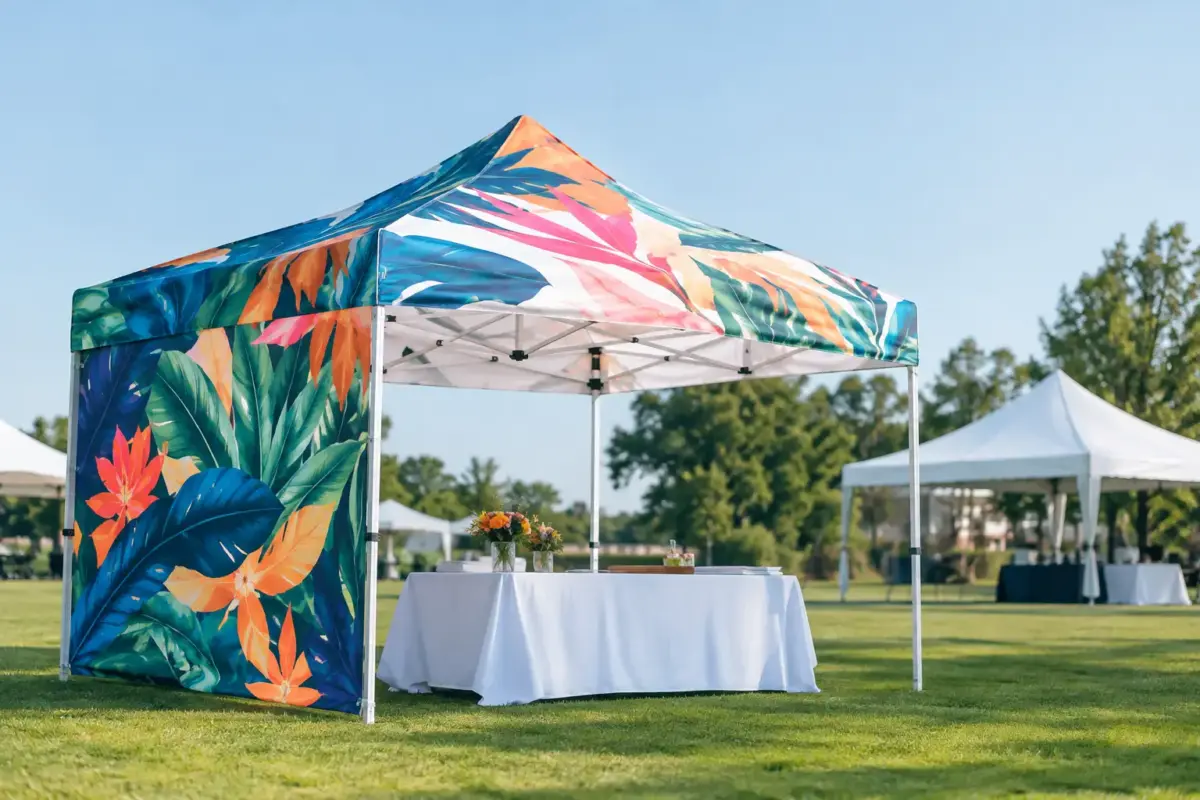
A printed marquee that looks sharp at 8 am but fades, flaps or loses its shape by lunchtime is not doing its job. Digital fabric printing gives businesses, clubs and event teams a way to put serious brand presence into equipment that also has to handle sun, wind, dust and repeated pack-downs.
For Australian outdoor events, the result is more than a logo on a roof. It is a branded shelter, sales point, registration area or team base that can be recognised from across a busy oval, market lane or trade site. Done properly, it turns practical infrastructure into a high-visibility asset worth using again and again.
What Is Digital Fabric Printing?
Digital fabric printing applies a design directly to textile-based products rather than adding a separate vinyl sticker or surface graphic after manufacture. For custom marquees, flags, table covers and media walls, dye-sublimation is commonly used on polyester fabrics.
The process starts with a high-resolution digital artwork file. The design is printed using specialist inks, then heat and pressure transfer the dye into the fibres of the fabric. Rather than sitting on top of the material, the colour becomes part of it. That matters outdoors: the finished fabric remains flexible, folds down neatly and presents a clean, professional finish without the heavy feel of an applied graphic.
A well-produced print can carry full-colour logos, photographic elements, gradients and detailed campaign artwork across large areas. It gives a local sporting club the same visual impact as a national activation, provided the artwork, fabric and structure are specified properly.
Why Printed Fabric Performs Better at Events
The biggest advantage is visibility. A plain gazebo with a small banner may provide shelter, but it does little to help people find you in a crowded event environment. A custom-printed roof, walls and flags create a much larger branded footprint. People can spot your location before they are close enough to read a brochure or speak to staff.
Fabric printing also suits equipment that needs to work hard. Polyester canopy material is designed to be folded, transported and installed repeatedly. With dye-sublimation, the printed area does not crack or peel in the way an applied film can when it is continually creased and handled.
There is a practical financial case as well. A quality printed marquee can be used for markets, school carnivals, race days, community festivals, trade shows and field work. Instead of paying for disposable signage at each event, you are investing in reusable branded infrastructure. The return depends on how often you activate, but for organisations with a regular events calendar, that difference adds up quickly.
Digital Fabric Printing Is Only One Part of the Build
A standout print cannot compensate for a weak frame or poor site setup. This is where buyers need to separate promotional products from commercial event equipment.
The canopy fabric needs a structure that keeps it taut and stable. A loose roof makes even excellent artwork look second-rate, while a frame that flexes under load will shorten the useful life of the canopy and its printed panels. For exposed sites, frame grade, connector design, leg profile, wall configuration and tie-down points all matter as much as the print itself.
Wind rating deserves particular attention. A rating applies to a specific structure and setup, not simply to the fabric roof. It may depend on correct anchoring, weights, pegs, straps and suitable ground conditions. Never treat a printed marquee as a set-and-forget billboard. Weather changes fast, particularly on open sports grounds, foreshore sites and regional event spaces.
At Mountain Shade, custom printing is paired with heavy-duty commercial marquee options, accessory systems and practical design support. That combination matters because the final product must look better and perform reliably when it is in front of customers.
Choose Fabric for the Job, Not Just the Artwork
Most branded event products use polyester because it works well with dye-sublimation and offers strong colour reproduction. However, not every polyester fabric is the same. Fabric weight, coating, water resistance, fire-retardant requirements and stitching quality can affect suitability for your intended use.
A lightweight flag needs movement and visibility, so it is specified differently from a marquee roof that must provide meaningful shelter. A fitted table cover needs stretch and a crisp printed finish. A media wall needs enough structure and tension to remain flat in photos. Ask what material is being printed, how it will be finished and how it is intended to be used.
For long days outside, also consider where the print will be seen. Dark colours can create a premium look, but they absorb more heat. White roof areas can help keep a shelter brighter underneath, while coloured valances, walls and flags still deliver strong brand impact. The right balance depends on your logo, event type and how much shade your team needs to work comfortably.
Artwork That Prints Cleanly at Marquee Scale
A design that works on a mobile screen can fail badly across a three-metre roof panel. Small type, fine lines and low-resolution logos become obvious once printed at full scale.
Start with a proper vector logo where possible, such as an AI, EPS, SVG or print-ready PDF file. Vectors can scale without becoming pixelated. High-resolution raster files can work too, but they need to be supplied at the dimensions required for the product. A screenshot copied from a website is rarely good enough for a large-format canopy.
Keep the main message simple. Your business name, logo, key service and a readable phone number or web address are generally more effective than trying to fit an entire sales brochure onto a roof. Event attendees often see a marquee while walking, driving past or standing in a queue. They need to understand who you are in seconds.
Colour should be managed realistically. Screen colours are produced with light, while fabric print uses inks and can look different under direct sun, cloud cover or indoor lighting. Brand colours can be closely matched, but exact results vary with fabric type and production method. A visual mock-up is valuable because it lets you check logo placement, scale, panel breaks and overall balance before production begins.
Use Each Surface With Purpose
The roof is usually your long-distance identifier. Valances are ideal for business names and short messaging at eye level. Walls provide the largest uninterrupted area for campaign graphics, sponsors, product imagery or privacy. Flags extend your presence beyond the marquee and help draw traffic from a distance.
This does not mean every available panel needs a graphic. Too much information can look cluttered and dilute the message. A strong design uses clear hierarchy: brand first, essential information second, supporting visual elements last.
Common Buying Mistakes to Avoid
The first is choosing a print based only on price. Cheap fabric and low-grade frames may look acceptable in product photos, but outdoor use exposes shortcuts quickly. Consider the full package: print quality, frame strength, canopy material, warranties, spare-parts availability and the anchoring equipment included.
The second is ordering before confirming the layout. A roof logo placed across a seam, a wall design interrupted by a zip, or text positioned too close to a hem can undermine the finished product. Request a visual proof and inspect it carefully. Check spelling, colours, logo versions and contact details before approval.
The third is overlooking setup conditions. If your team attends hardstand events, pegs alone will not be enough. You may need leg weights, sandbags or other approved ballast. If you attend windy regional shows, invest in tie-down systems and train the team to use them correctly. The most impressive print in the world is not worth a safety risk.
Finally, avoid treating storage as an afterthought. Pack the canopy dry whenever possible, remove dirt before it becomes embedded and use a wheely bag or protective case for transport. Regularly inspect frame joints, fabric seams and tie-down straps. Good care protects both the equipment and the brand image it carries.
Building a Branded Setup That Lasts
The most effective event setups are planned as a system. A printed marquee provides shelter and a highly visible base. Matching flags build presence beyond the site boundary. A table cover creates a professional customer-facing counter, while a media wall can provide a clean backdrop for photos, presentations or sponsor content.
Start with the event environment and work backwards. A weekend market stall has different needs from a council information hub, race team pit area or travelling trade display. Consider team numbers, product stock, customer flow, transport space, setup time and expected weather. Then select the print coverage, structure size and accessories that suit the job.
Bring your logo files, key message and event goals to the design stage early. The best digital fabric printing does not merely decorate a shelter. It gives your team a dependable base that is easy to find, safe to operate and hard for customers to forget.
