
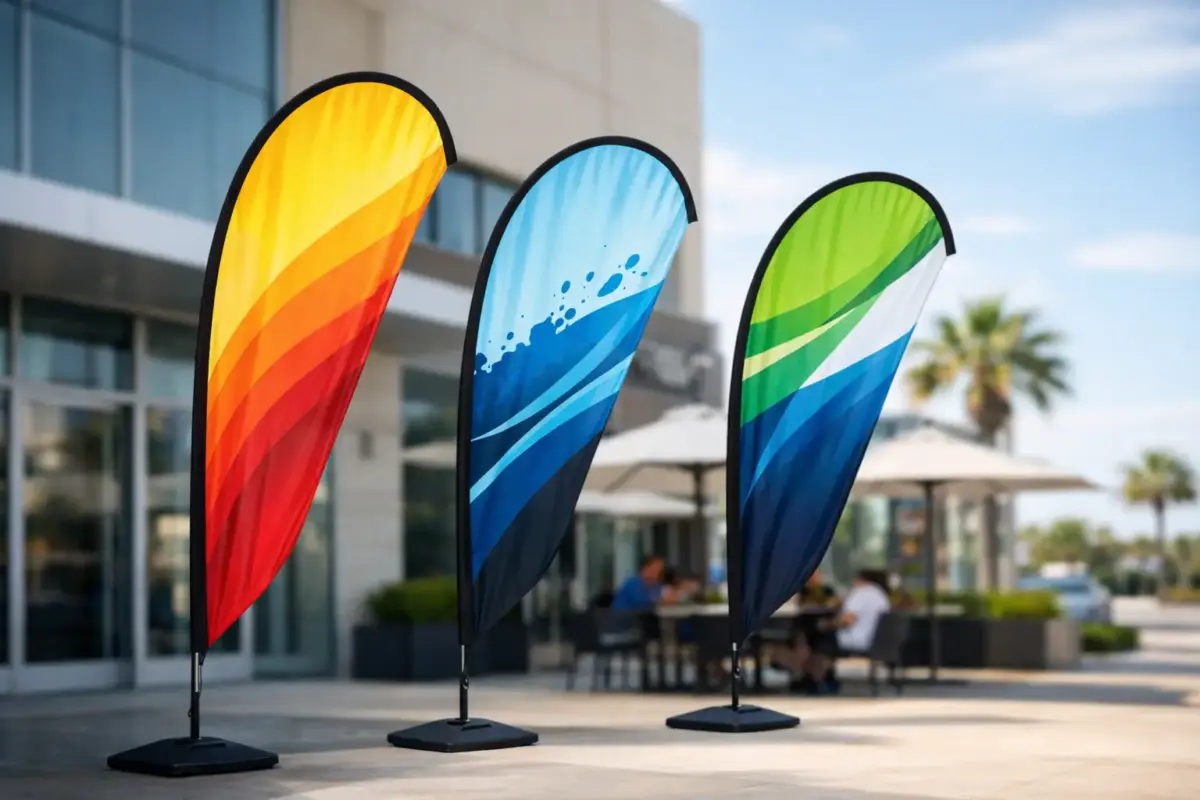
A busy oval, market lane or trade-show entrance gives people only seconds to notice your organisation. Custom printed teardrop flags put your logo, offer or message above the crowd line, where it can be seen from a distance without needing a large footprint. They are fast to deploy, easy to transport and built to work beside your marquee, table display or activation space.
The difference between a flag that earns its place and one that becomes a frustrating one-event purchase comes down to more than the print. Flag shape, pole construction, fabric quality, base selection and artwork all affect how it looks and performs outdoors. Buy for the conditions and the way your team actually works, not just for the lowest starting price.
Why custom printed teardrop flags work harder
The teardrop shape stays taut around the curved pole, including when the wind drops. That matters when your message is a logo, event name, directional cue or sponsor mark. A loose flag can become difficult to read. A teardrop flag maintains a clean, recognisable display face across changing conditions.
For businesses and clubs that attend recurring events, this makes a real operational difference. Set flags at the entrance to a pop-up gazebo, place them beside a registration desk, line a race transition area or use them to identify a council information point. They give visitors a clear visual reference before they are close enough to read signage at ground level.
They are also one of the most practical ways to extend the reach of branded shelter. A printed marquee creates a strong home base. Teardrop flags draw attention towards it from across the venue. Used together, the setup looks organised and gives your team a more credible presence than a bare tent and a temporary paper sign.
Start with where the flag will be used
A flag intended for a sheltered indoor exhibition needs different hardware from one that will stand on grass at a coastal sports carnival. Before choosing a package, consider the surface, expected wind, available setup time and whether staff will move the display during the day.
Grass, dirt and sports fields
A ground spike is a practical choice for grass and compacted soil. It creates a low-profile installation and keeps walkways clear, provided the surface allows proper penetration. It is well suited to sports clubs, community days, field demonstrations and agricultural events.
Do not treat a ground spike as a solution for every outdoor site. Dry, rocky ground and established hard surfaces can prevent safe installation. If the spike cannot be driven in securely, use a suitable weighted option instead of forcing it.
Concrete, asphalt and indoor floors
For footpaths, car parks, exhibition halls and other hard surfaces, a flat base or water-filled base gives you flexibility. A flat base suits a stable, level surface where the flag will remain in one position. A water base is easier to transport empty, then fill on site, which can be useful when space in the ute or event vehicle is limited.
The trade-off is simple: a base must match the wind exposure. A lightweight base may be convenient to carry, but it is not a substitute for appropriate ballast in exposed conditions. Plan your placement carefully, keep the flag out of vehicle paths, and never leave it unattended if weather is building.
Sand, beaches and uneven ground
Beach activations, surf events and regional field days often need more site-specific thinking. Sand can shift, and uneven ground can reduce the stability of some base styles. Select a system designed for the terrain, add appropriate weight where needed, and inspect it throughout the day. Equipment may be heavy duty, but safe setup still relies on the operator making sound decisions.
Choose a size people can actually see
Bigger is not automatically better. The best height depends on viewing distance, venue restrictions, surrounding structures and the message on the flag.
A smaller teardrop flag can work well at a market stall, beside a table or near a building entrance where visitors are already close. Mid-sized flags are strong all-rounders for school events, sporting clubs and promotional displays. Larger flags make sense for forecourts, open ovals, roadside events and major activations where you need to stand above gazebos, vehicles and crowds.
Think about the visual line from the main approach. If people are arriving from 50 metres away, a small logo placed low on a short flag will not do the job. If the display is in a tight indoor hall, an oversized flag may dominate the space or breach venue height rules. Measure the site where possible and ask for a visual mock-up before production.
Build artwork for movement, not a brochure
Flag printing is not the same as printing a flyer. The fabric moves, the flag curves around the pole and viewers may only see it for a moment. Strong flag artwork is direct, high contrast and designed around fast recognition.
Keep the main logo or key message large. Use a simple colour palette that remains clear at distance. Where you need a call to action, use short wording such as a website address, event name or a simple instruction. Long paragraphs, detailed price lists and small contact information are better placed on a banner, table cover or marquee wall where people can stand and read.
Leave breathing room around the edges, particularly near the pole sleeve and pointed areas of the shape. Important text pushed into these zones can become distorted or hard to see. A good design team will check the artwork against the flag template, match brand colours as closely as possible through dye-sublimation printing, and show you a proof before the job proceeds.
Double-sided printing can be worth considering when visitors will approach from either direction and brand accuracy on both faces is essential. It generally comes with a higher investment and extra material, so it is best reserved for high-visibility applications. For many event setups, a well-designed single-sided flag provides excellent impact and value.
Hardware is where repeat-use value is won
The printed skin gets attention, but the pole and base determine whether your display remains reliable over a full calendar of events. Look for pole sections that are easy to assemble, engineered to flex appropriately and supplied with a carry bag that protects them between jobs. Fibreglass and composite pole systems are commonly used because they combine light handling with the flexibility required for flag shapes.
Check that replacement parts are available. Poles, bases and printed skins can have different service lives, especially when equipment is shared among staff or packed in and out of event vehicles. Being able to replace one part is far more practical than discarding an otherwise usable display.
A proper carry bag also matters. It keeps flag components together, reduces damage in storage and makes bump-in faster. When your team is setting up a gazebo, weights, tables, stock and signage before gates open, small time savings add up quickly.
Set flags up with the same care as shelter
A teardrop flag is lightweight compared with a commercial marquee, but it still needs responsible installation. Position it clear of vehicle routes, doorways, emergency access paths and low overhead hazards. Make sure the pole is fully seated in the base and the flag sleeve is correctly fitted before raising it.
Monitor weather rather than assuming the original setup will remain safe all day. Strong gusts can arrive quickly at exposed grounds, waterfront locations and open car parks. If conditions deteriorate, lower and pack down the flag. No promotional asset is worth creating a hazard for customers, volunteers or staff.
For a unified event footprint, place flags deliberately rather than scattering them around the site. Two flags can frame the front of a 3 x 3 m marquee. A row of flags can guide people from parking to registration. One large flag can mark a meeting point or identify your location within a crowded festival. The best layout supports how people move through the venue.
Make your branding investment work across more events
Custom printed flags are most cost-effective when they are designed for repeat use, not a single campaign date. Avoid event-specific wording unless the event itself is recurring. A strong master brand design can be used at markets, race days, school functions, trade shows, open days and community activations for years.
If you run several programs, consider a consistent visual system: the same core colours and logo treatment across flags, printed marquees, media walls and table covers, with separate flag skins for individual departments, sponsors or campaigns. This keeps the overall setup professional while giving each activation a clear purpose.
Mountain Shade can help turn that requirement into a practical display package, with free visual mock-ups that let you assess flag size, artwork and placement before committing to print. Bring the event brief, site details and existing brand files to the conversation. The right teardrop flag should not merely fill empty space – it should point people exactly where you want them to go.
