
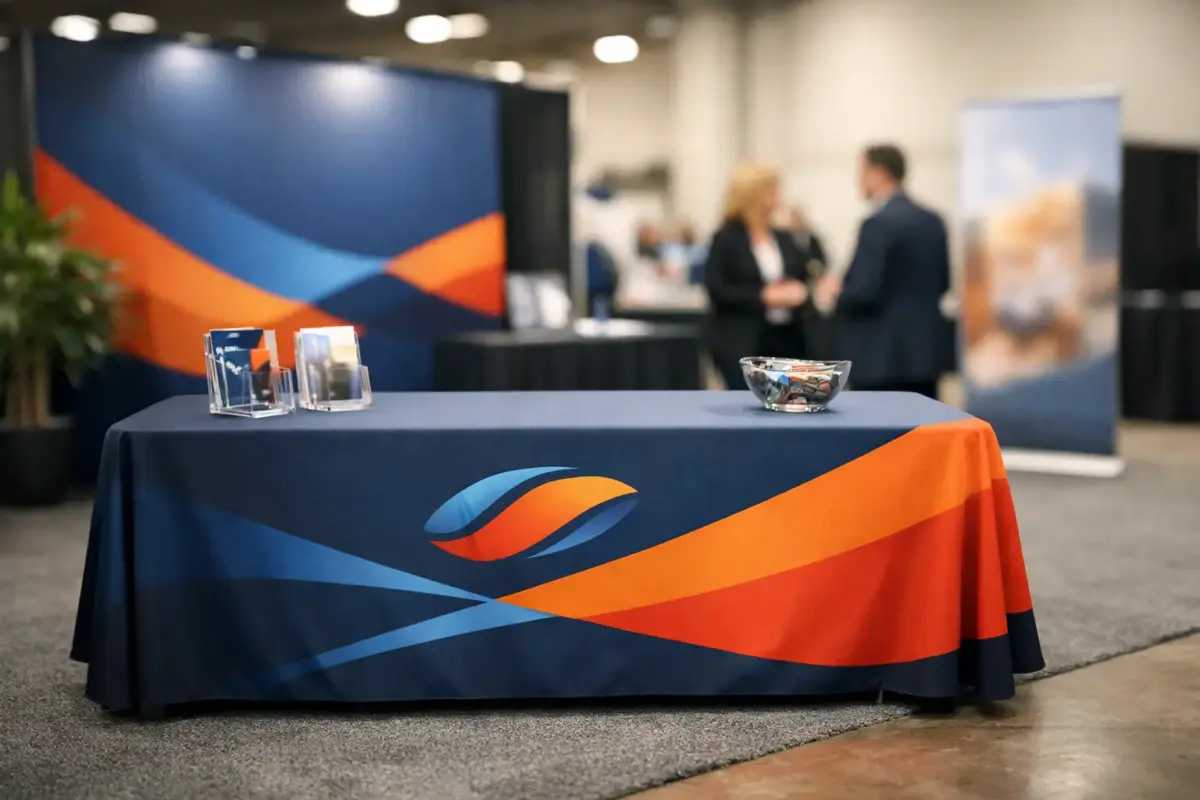
Your trestle table can either look like borrowed furniture or become the front edge of your brand. A branded tablecloth for trade show use turns that otherwise plain surface into a high-impact display area, covering stock boxes, brochures and the clutter that collects below the tabletop while putting your logo and message where visitors can see it.
For Australian businesses that exhibit regularly, a printed table cover is not a throwaway extra. It is a compact, reusable brand asset that works at trade shows, conferences, school events, sporting presentations, market days, council activations and product launches. Get the fit, fabric and artwork right, and it keeps earning its place in the event kit.
Why a branded tablecloth earns its space
Trade show stands are busy places. Staff need room to talk, demonstrate products, process enquiries and store supplies. A table is useful, but an uncovered one can make even a well-planned stand look unfinished. A custom-printed cover gives the setup a clean, deliberate base without taking up another square metre of floor space.
It also gives your branding a second job. Your marquee roof, media wall or pull-up banner may be visible from across the venue, while the tablecloth works at close range. It reinforces who you are as visitors step up, collect a brochure or scan a QR code. That repeated visual cue matters when attendees are meeting dozens of exhibitors in one day.
For outdoor activations, the benefit is even more practical. A full-length cover conceals cartons, coolers, personal bags and spare promotional material from public view. Your crew can keep the workspace functional without making the stand look messy.
Selecting the right branded tablecloth for a trade show
The best choice depends on the table you use, how often you exhibit and whether the event is indoors, outdoors or both. Start with the table, not the artwork. Measure its length, width and height when set up, then confirm whether you need an open rear for access or full coverage on all sides.
Fitted, stretch or loose table covers?
A fitted table cover creates a crisp, tailored look. It is a strong option for indoor exhibition halls, registration desks and corporate displays where clean lines are the priority. Because it follows the table shape, it delivers consistent presentation from event to event.
Stretch covers use elastic fabric to pull tightly around the table legs. They look sharp and stay in place well in busy environments, but they are not always the best fit for rough ground or tables with unusual leg designs. If your team needs to access stored stock under the table throughout the day, a stretch cover can be less convenient.
A loose or throw-style cover offers flexibility. It suits different table configurations and makes it easy to reach supplies underneath. The trade-off is that it needs to be sized properly and arranged neatly. A cover that pools on the floor can become a trip hazard, collect dirt outdoors and look untidy in photographs.
For many exhibitors, a fitted full-cover design strikes the right balance: professional front and sides, concealed storage and a stable finish. If you use standard 1.8 m trestle tables, choose a cover made specifically for that footprint rather than trying to force a generic cloth to work.
Think about access before ordering
A tablecloth should help your team work, not slow them down. If you are displaying samples on top and carrying stock underneath, consider an open-back configuration. It keeps the customer-facing sides fully branded while allowing staff to grab items without lifting fabric or crawling around the table.
Full-cover styles are better when visual polish and concealment are the main goals. They work particularly well for reception points, prize tables, information desks and trade show displays where visitors can approach from several directions.
Print design that works from the aisle
A tablecloth is not a brochure. It needs to be understood quickly, often from a few metres away and among competing signs, lights and product displays. Lead with one clear visual priority – usually your logo, business name or campaign message.
Avoid squeezing every service, phone number and social handle onto the front panel. Small type gets lost, especially when people are standing in front of the table. If detailed information is needed, use a brochure, screen or banner. Let the table cover establish your identity and make the space look professionally branded.
Keep important elements away from seams, corners and the lower edge. Those areas can fold, sit behind table legs or be obscured by visitors. A strong design generally places the main logo high and centred on the front panel, with secondary branding on the side panels if the table will be visible from multiple angles.
Colour choice needs practical thinking too. Bright colours can pull attention in a crowded hall, but print should still align with your existing brand. Darker backgrounds often hide minor marks from outdoor use, while white can look premium and clean when maintained properly. It depends on your event mix, staffing and how much handling the cover will receive.
High-quality dye-sublimation printing is particularly suited to event branding because the colour is printed into the fabric rather than sitting as a heavy surface layer. The result is strong, detailed colour reproduction and a professional finish that supports repeat use. Supply clean logo files and follow the artwork template exactly. If you are unsure how a logo will sit across the panels, request a visual mock-up before production.
Fabric, finish and durability matter
A sharp print is only half the job. Trade show equipment gets packed, carried, unfolded, bumped by trolleys and used in different venues. Flimsy material may cost less at the start, but it can quickly look tired after a few events.
Choose a purpose-made printed table cover built from quality fabric with finished edges and stitching designed for regular setup. The material should drape well enough to look polished, while still being practical to fold, transport and clean. For touring teams, clubs and event operators, that balance is what makes the cover a useful long-term asset rather than event merchandise destined for the rubbish after one activation.
Outdoor use brings extra variables. Wind can catch loose fabric, damp grass can dirty hems and uneven ground can affect how the cover sits. Pair the cover with a stable table, keep corners clear of walkways and use appropriate weights or tie-down systems for your wider display structure. A printed tablecloth does not replace proper shelter anchoring or site safety planning.
Build a display, not just a table
A table cover performs best as part of a coordinated setup. Match its colours and logo treatment to your printed marquee, flags, media wall or banners so visitors immediately recognise one complete brand presence. This is especially valuable at outdoor events where people may see the gazebo first, then approach the table later.
Scale matters. A single tablecloth can be enough for a compact indoor stand, sampling station or registration desk. A larger activation may need two matching tables beneath a branded 3 x 3 m marquee, with flags placed beyond the footprint to draw people in. The goal is not to cover every available surface with graphics. It is to create a clear hierarchy: visible from distance, credible at the stand and easy to use for staff.
Mountain Shade can help turn existing artwork into a consistent event package, with free visual mock-ups helping teams check the table cover against other printed display equipment before it goes to production.
Make setup and pack-down easier
The right cover should be simple enough that any staff member can set it up properly. Label the storage bag, include a photo of the finished orientation if the print has a defined front, and make it part of the standard event checklist. This small step prevents the common problem of a tablecloth being fitted backwards just before doors open.
After an event, shake out loose dirt before packing it away. Treat spills promptly according to the fabric-care instructions, make sure the cover is dry before storage and fold it rather than cramming it into the bottom of a crate. A clean, dry cover is ready for the next job and protects the professional look you paid for.
If you attend the same events each year, consider keeping a dedicated display kit: table cover, banners, cables, brochures, tape, weights and basic cleaning supplies. It reduces last-minute scrambling and makes your brand presentation more consistent, even when the staff roster changes.
A well-made branded tablecloth will not replace a strong sales conversation, but it gives that conversation the right setting. Choose one that fits your table, carries a simple high-visibility design and stands up to repeated Australian event use. Then make it part of the equipment your team can pull out, set up and trust every time the brand needs to be seen.
