
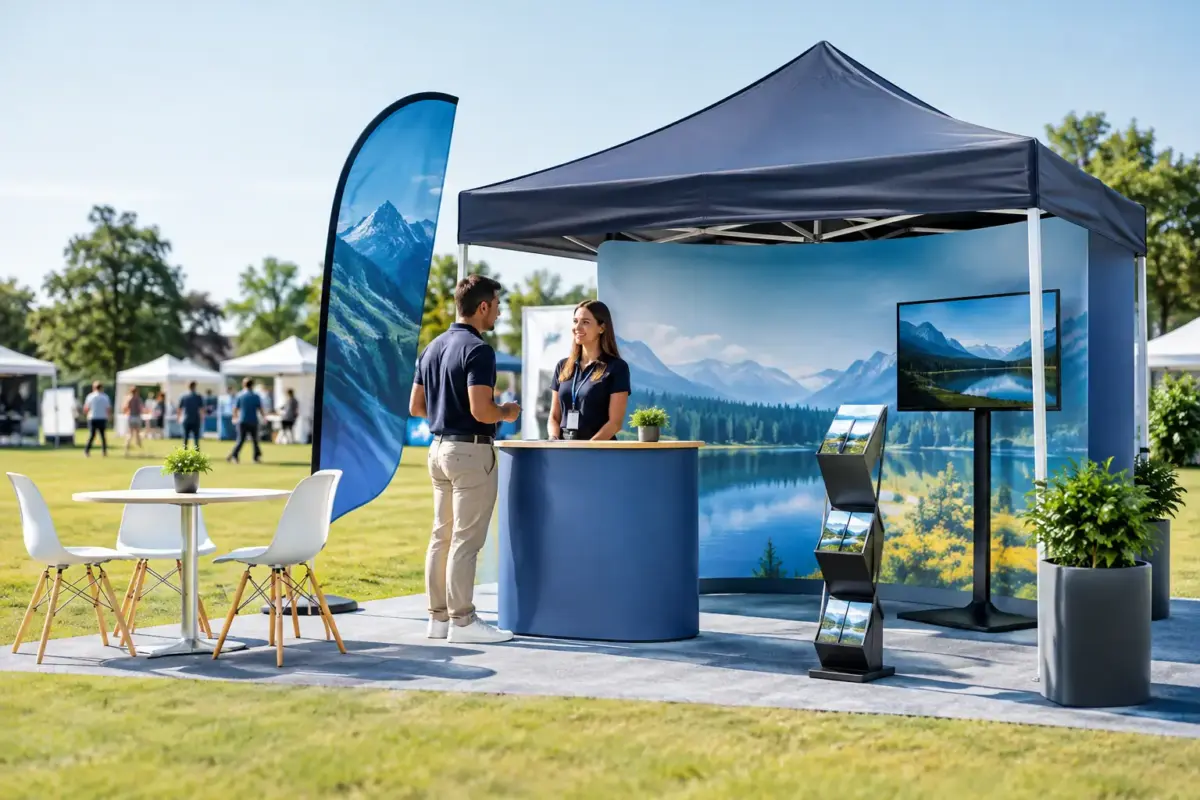
A windy Saturday market, a regional sports carnival and a three-day trade show all demand different things. The right event display packages do more than put your logo in front of a crowd. They give your team dependable shelter, a clear working area and a brand presence that still looks sharp after repeated pack-downs, transport and rough outdoor weather.
That is why buying a package should not mean grabbing the cheapest marquee and adding a flag at the checkout. Your display needs to suit the job, the site and the number of events you plan to work each year. A serious setup is an operational asset – one that earns its place every time your team arrives, sets up quickly and looks ready for business.
What a Proper Event Display Package Includes
The strongest packages start with a heavy-duty pop-up gazebo or folding marquee, then add branding and accessories that make the structure safer and more useful. For a market trader, that may be a 3 x 3 m printed marquee with side walls, a wheely bag and leg weights. For a council activation, it could be multiple branded shelters, feather flags, table covers and a media wall that creates a clear public-facing hub.
The key is to treat each item as part of one working system. A printed roof gets attention from a distance. Walls give you weather protection and more printable space at eye level. Flags help visitors find you across a busy oval or exhibition entrance. Tables, banners and backdrops make the space look organised once people step under the canopy.
Shelter is the foundation
Start with the footprint your team actually needs. A compact 3 x 3 m gazebo works well for market stalls, sampling teams, sporting clubs and simple registrations. A 3 x 4.5 m or 3 x 6 m marquee gives you extra room for stock, product demonstrations, treatment stations or multiple staff members. Bigger is not automatically better if the site is tight, but a cramped stand can make customers walk straight past.
Frame grade matters just as much as size. Commercial aluminium frames are built for frequent deployment and transport, while heavy-duty steel options suit buyers who prioritise a tough, budget-conscious structure. Look beyond a vague claim of strength. Leg profiles, connector design, truss construction and replacement-part availability tell you whether a frame is built for repeat work or a handful of calm-weather uses.
For exposed locations, wind performance and tie-down requirements must be part of the conversation from the start. Selected heavy-duty 3 x 3 m structures can carry wind ratings up to 100 km/h when correctly configured, secured and used in suitable conditions. That is a serious capability, not a reason to ignore site conditions, weather warnings or safe operating procedures.
Branding should work at more than one distance
Your roof is seen from across the event. Your walls, table cover and banners are seen when people are close enough to make a decision. A good package uses both viewing distances rather than placing one oversized logo on everything.
Dye-sublimation printing gives you full-colour coverage, crisp logos and the freedom to use brand colours properly. A clean roof design with strong logo placement is usually more effective than filling every panel with copy. Put key services, campaign messaging or sponsor logos on the walls, banners and media backdrop where people have time to read them.
If your organisation attends mixed events, choose artwork that can keep working. A well-designed custom marquee can serve a school fete, a community open day, a trade expo and a regional field day without looking dated after one campaign. Free visual mock-ups are valuable here because they let you check scale, colour placement and logo visibility before production begins.
Build Event Display Packages Around the Job
A package needs to reflect what happens beneath it. The most practical buying decision comes from mapping the team’s real setup routine, not choosing components in isolation.
For market operators, weather protection and a professional shopfront are the priority. A printed 3 x 3 m marquee, full or half walls, solid weights and a fitted table cover create a defined retail space. Add a wheely bag if the setup travels from market to market, because dragging an unprotected frame in and out of a ute will shorten the life of the gear.
For sporting clubs and race teams, visibility and fast setup tend to lead the brief. A branded gazebo gives members, officials or competitors shelter, while feather flags make the site easy to spot along a crowded sideline or paddock. Side walls can provide a more private recovery, registration or equipment area when conditions turn.
For councils, schools and community organisations, flexibility is often more valuable than a single fixed configuration. A matching fleet of printed marquees can be used separately across several activity zones, then joined visually with flags, banners and table covers. This approach keeps the public-facing look consistent while allowing staff to adapt to different sites.
Trade professionals and mobile service teams may need less promotional gear and more functional cover. A heavy-duty marquee with plain or lightly branded walls can become a temporary work area, check-in point, first-aid station or portable office. In these situations, strong frames, spare parts, reliable transport bags and proper anchoring are the features that protect productivity.
Do Not Treat Weights and Tie-Downs as Extras
The roof gets the attention, but the anchoring system does the hard work. Australian outdoor events can move from still conditions to sharp gusts quickly, especially near open ovals, coastal sites and showgrounds. Every marquee should have a site-appropriate method of restraint before it goes up.
Leg weights are ideal where pegs are not permitted or the surface is hard. Pegs and tie-down straps are often the better choice on grass or soil, provided they can be installed safely and securely. Many sites need a combination. The right answer depends on the surface, forecast, marquee size, wall configuration and event rules.
This is also where cheap package deals can become expensive. A lightweight frame paired with inadequate weights is not a bargain. It risks damage to equipment, disruption to your event and safety issues for staff and visitors. Build the cost of correct anchoring into the original purchase, rather than trying to improvise on event day.
Plan for Pack-Down, Storage and Repairs
An event display earns value through repeat use. That makes pack-down and maintenance part of the buying decision. Ask who is carrying the equipment, how far it needs to travel from vehicle to site and where it will be stored between events. A wheely bag, labelled wall bags and protective storage may sound basic, but they help a team set up faster and avoid lost parts.
Choose a supplier that can support the display after the first event. Replacement roofs, walls, frame sections, connectors and spare parts matter when one damaged component would otherwise sideline the entire setup. For organisations with a busy annual calendar, this support can be the difference between a long-term infrastructure purchase and another disposable promotional expense.
It also pays to think about growth. You might begin with one printed gazebo, then add matching flags, a media wall or an additional marquee as the event program expands. Keeping colours, logos and print files consistent makes each new piece look intentional rather than bolted on.
Make the Package Easy for Your Team to Use
Before approving artwork or placing an order, have the people who will set up the display review the plan. They will spot practical questions early: Is there enough room for stock? Can two staff members carry the frame? Does the site allow pegs? Will the table hide the logo on the front wall? Where will customers enter when rain comes through sideways?
Mountain Shade can help turn those answers into a purpose-built package, with design support, free mock-ups and commercial-grade options matched to the way your organisation operates. The best display is not the one with the most pieces. It is the one your team can deploy confidently, secure properly and use often enough to become a recognised part of your brand wherever the work takes you.
