
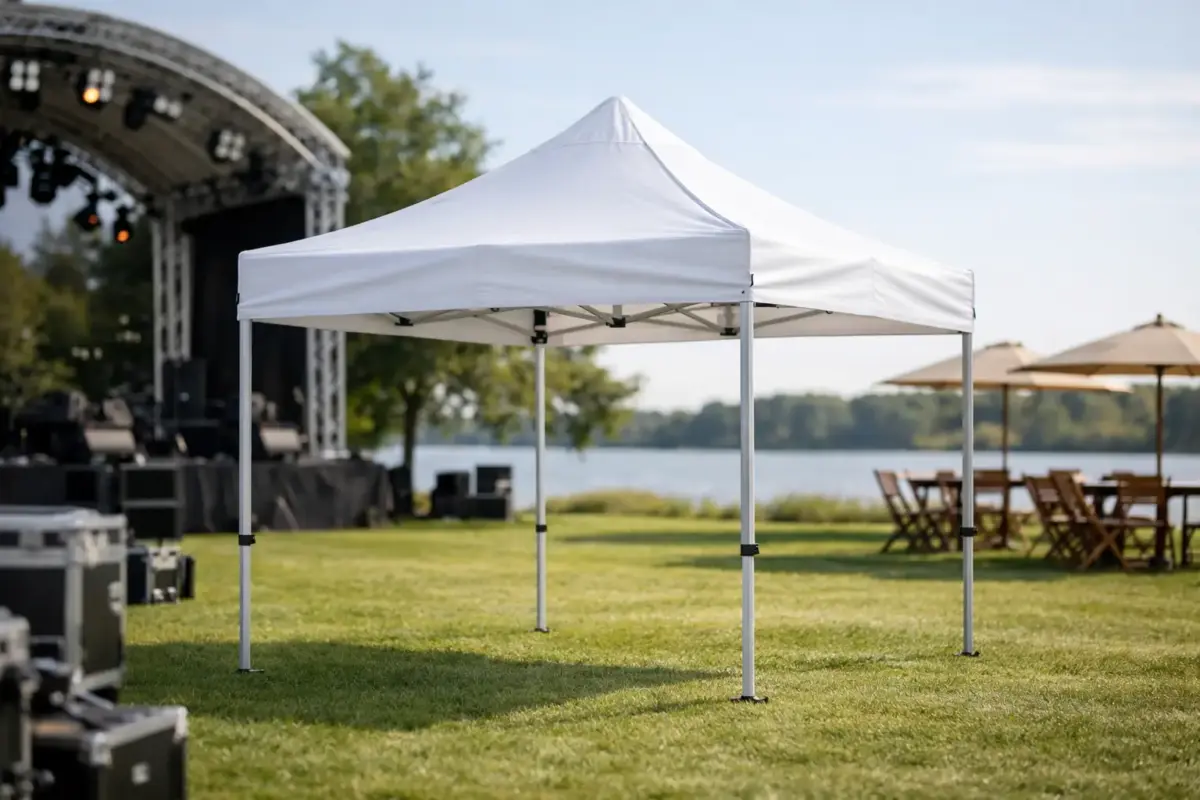
A folding marquee 3×3 is often the first structure unloaded from the ute and the last thing people remember at an event. It is where customers stop, athletes regroup, staff check in and your brand stays visible when the weather turns. For regular outdoor work, markets, community days or race meetings, a 3 x 3 m marquee needs to do more than look presentable for a few hours. It needs to set up quickly, stand firm and keep performing across repeat jobs.
The compact 3 x 3 m footprint is popular for a reason. It gives you nine square metres of covered space without demanding a large site, a truckload of equipment or a complicated setup crew. But not every pop-up is built for commercial use. The right choice comes down to frame grade, roof fabric, printing method and how seriously you approach anchoring.
Why a folding marquee 3×3 earns its place
A 3 x 3 m folding marquee is one of the most useful sizes in an event kit. It is large enough for a market stall with stock, a registration desk, a merchandise point or a small hospitality area. It is also compact enough to fit along a footpath activation, beside a sporting field, in a school courtyard or within a row of exhibitors.
For marketing teams, the roof provides a high-impact canvas visible well beyond the counter. Add printed sidewalls and the structure becomes a branded space rather than a table sitting under plain fabric. For councils, clubs and operational teams, the same marquee can become a sign-on point, first-aid station, information hub or sheltered work area.
That flexibility is valuable only when the unit can handle repeat setup and pack-down. Cheap recreational frames may suit an occasional backyard gathering, but they are not a smart long-term purchase for organisations working through Australian sun, wind, rain and frequent transport. A commercial marquee is infrastructure. It should be selected with that in mind.
Start with the frame, not the price tag
The frame carries the entire load. It determines how the marquee feels when opening, how much movement it has in wind and how well it survives constant use. Look closely at the leg profile, wall thickness, truss design, connector construction and the locking points that hold the frame at full height.
Commercial-grade aluminium frames are a strong choice for businesses that need corrosion resistance, manageable weight and regular deployment. Heavy-duty steel options can also suit certain applications where additional mass and strength are priorities. Neither material is automatically better in every setting. The key is choosing an engineered frame class that matches the frequency of use, transport demands and expected conditions.
A heavier frame may cost more and take a little more effort to move, but it usually pays back through stability and service life. Lighter units can make sense for low-risk, occasional indoor or calm-weather use. If your team is setting up every weekend, travelling between regional events or using the marquee as a public-facing workspace, frame strength should be non-negotiable.
Wind ratings need context
Wind ratings are useful, but only if you read them properly. A stated rating applies to a specific frame and setup configuration, usually with appropriate weights, tie-downs and ground conditions. It does not mean a marquee can be left unattended in severe weather or deployed without anchors.
Selected 3 x 3 m commercial structures can be rated up to 100 km/h when configured correctly. That is a serious performance benchmark, but safe operation still depends on site assessment, installation and active weather management. If conditions deteriorate, lower the marquee or pack it down. No portable structure should be treated as permanent shelter.
Choose roof fabric that can work as hard as the frame
The roof has two jobs: protect the people and equipment beneath it, and present your organisation properly. Heavy-duty polyester fabric with a quality protective coating is a practical choice for outdoor work. It should offer dependable water resistance, UV protection and colour retention through repeated use.
For branded applications, dye-sublimation printing delivers colour that is integrated into the fabric rather than sitting as a surface layer. This creates cleaner graphics, sharper detail and a professional finish from close range as well as across a busy event site. It is especially effective for logos, photographic artwork, sponsor layouts and full-roof branding.
Think about visibility from every approach. A logo on one valance may be enough for a local market stall where people walk directly past. A sporting club, automotive team or national campaign may benefit from printing across all valances, roof panels and walls. The best layout depends on where people will first see you, not simply how much print area is available.
Mountain Shade can provide a free visual mock-up before production, giving your team the chance to check logo placement, colours and messaging while changes are still easy to make.
Build a 3×3 folding marquee package around the job
A marquee is rarely just a frame and roof. The accessories determine whether it works smoothly at the site. Start by considering the surface beneath it. On grass or soil, pegs and tie-down straps can provide effective anchoring. On concrete, bitumen or indoor floors, properly sized leg weights are the practical answer. Many organisations need both systems because venues change from one event to the next.
Sidewalls are equally job-specific. A back wall creates a cleaner branded backdrop and protects stock or staff from prevailing weather. Half walls can create a defined service counter without closing off the space. Full walls improve weather protection and security but can increase wind loading, so they make correct anchoring even more critical.
A wheely bag is worth considering if the marquee travels often. It protects the frame in transit and saves your team from dragging an awkward load across car parks, ovals and exhibition halls. Spare parts availability also matters. Feet, pins, roof components and wall sections can eventually wear or go missing. A structure that can be repaired is a better commercial investment than one that must be replaced after a minor failure.
Set up for safety and speed
The fastest teams are not the ones who rush. They use a consistent process. Before opening the frame, inspect the site for overhead hazards, uneven ground, drainage issues and wind exposure. Keep the marquee partially opened while fitting the roof, then raise it evenly with at least two people. For a busy activation, arrive early enough to anchor, check the locks and position walls before customers arrive.
Once erected, all legs should be weighted or tied down as required by the conditions and venue rules. Do not rely on a table, a carton of stock or a single improvised weight to secure one corner. Purpose-built weights and tie-down systems are designed to keep the load where it belongs.
At pack-down, dry the roof where possible before storing it. If wet packing cannot be avoided, unpack and dry it at the next opportunity. This small discipline helps prevent mould, odour and premature fabric damage. A quick check of frame joints, straps and roof seams after each event will also catch small issues before they become a lost trading day.
When 3 x 3 m is right, and when it is not
The 3 x 3 m format is ideal when space is limited or you need several branded stations across a site. Two matching units can create separate check-in and merchandise areas, while a line of marquees can form a professional event frontage. It is also a practical size for teams that need to transport and deploy equipment without a large crew.
However, one 3 x 3 m unit may be too tight for a busy catering operation, a large product display or an all-day work crew. In those cases, a 3 x 6 m marquee or a connected multi-marquee layout may provide better coverage and traffic flow. Bigger is not always better if the site is narrow, exposed or difficult to anchor. Choose the footprint that lets people work safely, serve customers comfortably and maintain strong visibility.
A well-specified folding marquee 3×3 gives your team a dependable base wherever the work happens. Select the frame for the conditions, print it for the audience and anchor it as though the weather has something to prove. When the gates open, your shelter should already be doing its job: making your operation look organised, capable and ready for whatever the day brings.
