
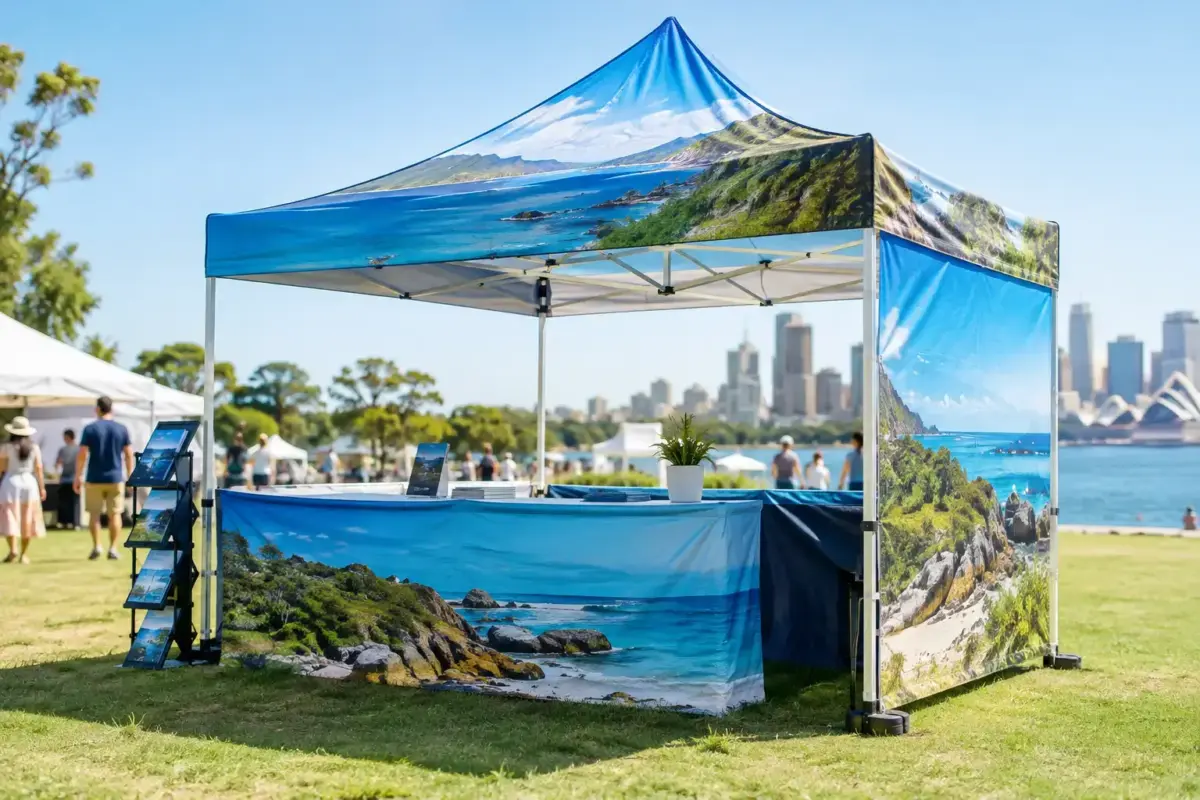
A custom gazebo printing review should not stop at whether the logo looks sharp on a website proof. For Australian businesses, clubs and event teams, a printed gazebo has to work harder than that. It needs to draw attention from across a busy oval or expo aisle, provide dependable shelter, pack down without drama and keep presenting your brand after repeated bump-in, bump-out and unpredictable weather.
The best custom-printed gazebo is not simply the cheapest frame with artwork added. It is a reusable piece of event infrastructure: part shelter, part sales counter, part meeting point and part high-visibility advertising. That changes how it should be assessed.
What a Custom Gazebo Printing Review Should Cover
Print quality matters, but it sits alongside frame engineering, fabric weight, hardware, accessories and the supplier’s ability to support you after delivery. A great-looking roof on a weak frame is poor value if a gusty market morning bends a leg or cracks a connector. Likewise, a heavy-duty frame with rushed artwork will not give a professional organisation the visual impact it paid for.
Start with how and where the gazebo will be used. A local school running two fetes a year has different requirements from a race team travelling every weekend, a council operating community activations, or a trade business using a branded setup at field days. Frequency of use, site exposure, crew size and transport all affect the right specification.
A 3 x 3 m gazebo remains the most versatile starting point for many activations. It gives enough covered space for a table, staff and display materials while remaining manageable to transport in a wheely bag. Larger configurations suit product demonstrations, registrations, food service and teams that need more operational space, but they also need proper ballast, tie-downs and a realistic setup plan.
Print Quality Is More Than a Bright Logo
Premium dye-sublimation printing produces colour that is integrated into the fabric rather than sitting as a surface layer. For branded gazebos, that matters because the roof will be folded, handled, transported and exposed to sun. The goal is bold, consistent colour that stays clean-looking through regular use.
A worthwhile review should look at three things: colour accuracy, artwork placement and coverage. Brand colours should be supplied in the correct format and checked before production, particularly where a logo relies on a specific shade. Fine lines, tiny type and low-resolution files can look acceptable on a computer screen but lose impact when enlarged across a canopy panel.
Placement is equally practical. Your primary logo needs to be readable at a distance, not hidden near a valance corner or broken across seams. On a busy event site, the valance is often the first area people see. A strong design uses this space for the organisation name, core message or web address, with larger roof panels carrying bolder graphics where appropriate.
Full-print roofs create maximum impact, while branded valances may be the better commercial choice for organisations that want a cleaner look or need to control cost. Printed walls add privacy, block low-angle sun and turn an open gazebo into a stronger branded backdrop. They are particularly useful for membership drives, product demonstrations, medical or community services, and trade displays.
Free visual mock-ups are valuable here. They give your team a chance to test whether the message reads clearly, whether the logo faces the main customer approach and whether the design looks balanced from all sides before the presses run.
The Trade-Off Between Detail and Distance
More artwork is not always better artwork. A roof crowded with sponsors, phone numbers, service lists and small social icons can become visual noise from five metres away. For most event applications, one clear brand message and high-contrast graphics do more work than a panel full of information.
If multiple sponsors must be included, reserve the most prominent positions for the major partner and use the walls or rear panel for secondary logos. The gazebo should be recognisable first, then informative when people come closer.
Frame Strength Decides the Long-Term Value
Australian outdoor conditions are hard on temporary structures. Strong sun, coastal air, hard ground and sudden wind changes are normal operating conditions, not rare exceptions. That is why frame class should carry as much weight in a custom gazebo printing review as the print finish.
Commercial-grade aluminium frames are a strong fit where weight, corrosion resistance and regular transport matter. Heavy-duty steel options can also suit specific applications where a substantial, cost-effective structure is required. The key is not the material name alone, but the complete engineering package: leg profile, wall thickness, truss design, connector construction, locking mechanisms and replacement-part availability.
Look for reinforced legs and quality connectors rather than generic descriptions such as “heavy duty”. A commercial gazebo should feel stable when opened, lock positively into height settings and tolerate frequent setup without looseness developing through the joints. When gear is being loaded into a ute before dawn or packed down after a long event, these details become obvious quickly.
For selected 3 x 3 m structures, wind ratings up to 100 km/h provide a meaningful benchmark of engineering capability. But a rating is not permission to leave a gazebo standing in dangerous conditions. Wind behaviour varies by site, surface and setup. Walls can increase wind load, and gusts around buildings, grandstands or open paddocks can be far stronger than expected.
Safe operation always means using the correct weights, pegs and tie-downs, monitoring conditions and packing down if the weather becomes unsafe. A good supplier will treat these accessories as core equipment, not optional afterthoughts.
Fabric, Walls and Accessories Change the Result
The canopy fabric must handle UV exposure, rain and repeated folding without becoming tired-looking. A water-resistant, commercial-grade roof gives more confidence than thin promotional fabric, especially for teams operating at weekend markets, sporting grounds and regional field days.
Walls are often the difference between a gazebo that merely shades people and one that works as a practical event base. A back wall creates a clean branded presentation and hides stored stock. Side walls offer weather protection and can define a queue, consultation space or service point. Half walls are useful where staff need an open counter while keeping the site professional and contained.
Do not overlook the gear that keeps the entire setup usable. Wheely bags protect the frame in transit and reduce strain on staff. Proper weight bags or steel weights are essential on hard surfaces. Pegs and ratchet tie-downs matter on grass, dirt and open sites. Awnings can add a welcome customer-facing area, but only when the frame and anchoring system are selected to support the added load.
A supplier with spare roofs, walls and frame parts can protect the investment over years of use. Replacing one damaged component is far more sensible than writing off an otherwise sound branded setup.
Price Should Be Measured Across Events, Not at Checkout
A low upfront figure can be tempting when you are comparing printed gazebo quotes. The better question is how many events the structure can realistically complete while still looking sharp and operating safely.
Consider the total package. Does it include printing on the required panels, a suitable frame, carry bag, roof, walls, weights or tie-down equipment? Are visual mock-ups and design assistance included? Is there a clear path to order replacement components if a wall is damaged or your campaign changes?
For organisations attending recurring events, a commercial printed gazebo can keep delivering long after the initial purchase. It provides shade for staff and customers, creates a recognisable location on site and reduces reliance on hired signage. That makes it easier to justify a stronger frame and better print specification.
Mountain Shade is built around this performance-first approach, pairing custom printing with commercial frame options, accessory systems and practical design support for Australian conditions.
Questions Worth Asking Before You Approve Artwork
Before committing to production, confirm the finished size, frame grade, printed surfaces and included accessories. Ask how the roof and walls attach, what the setup process involves, and whether replacement components can be supplied later. If the gazebo will attend exposed sites, discuss the anchoring plan before the event, not when the wind has already picked up.
Also check the artwork from the viewpoint of a passer-by. Can someone identify your organisation quickly? Does the design work from more than one direction? Is the main call to action appropriate for the distance at which customers will see it?
A printed gazebo earns its place when it makes your operation look organised before a staff member says a word. Choose the frame, print coverage and anchoring system for the conditions you actually face, and it will keep doing that job event after event.
