
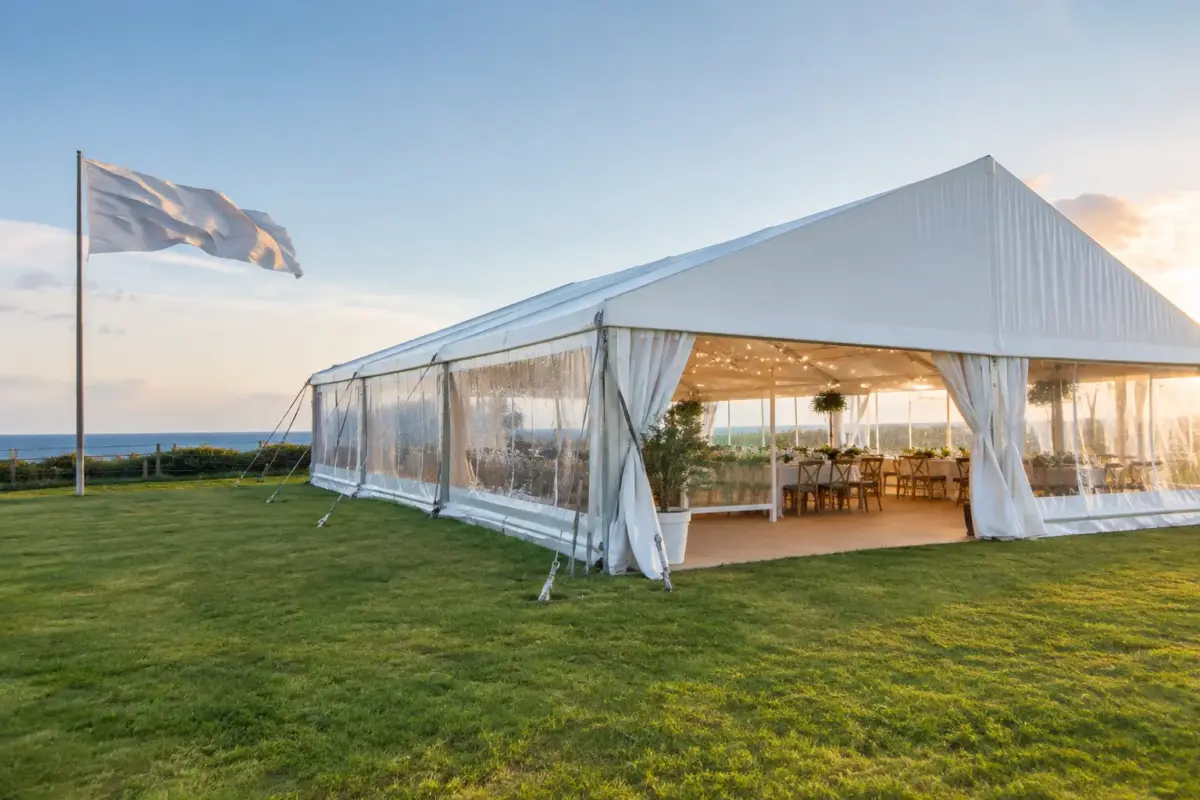
A busy market, sports carnival or regional field day can turn windy fast. One moment your marquee is drawing a crowd; the next, gusts are loading up the roof, walls and legs. That is why marquee wind ratings deserve more attention than a number on a product page. They affect safety, setup requirements, operational decisions and the working life of your equipment.
For Australian organisations that rely on outdoor shelter, a commercial marquee is not disposable event gear. It is a branded workspace, sales point, registration desk, first-aid station or team base. Choosing the right frame and securing it correctly gives you a structure that looks sharp and performs when conditions are less than friendly.
What marquee wind ratings actually mean
A marquee wind rating is the wind speed a structure has been designed or tested to withstand under stated conditions. Those conditions matter. A rating is not a blanket promise that every marquee can stay erected at that speed in every location, with every accessory fitted.
The figure may depend on the marquee size, frame configuration, canopy fitted, anchoring method, surface type and whether sidewalls are installed. A 3 x 3 m frame can behave very differently from a larger 3 x 6 m setup because the larger roof presents more surface area to the wind. Add full walls and you create a much bigger sail.
At Mountain Shade, selected 3 x 3 m heavy-duty structures are rated up to 100 km/h when set up to the required specification. That is serious performance territory, but it still does not remove the need for sound judgement. Wind ratings are a benchmark for a correctly assembled, properly anchored structure – not a reason to ignore a severe-weather warning.
A rating is only as good as the complete setup
The frame is the starting point. Commercial aluminium or steel legs, reinforced truss bars, strong connectors and secure roof attachment points all help a marquee resist movement and distortion. But a premium frame on its own cannot do the full job.
Anchoring transfers wind loads into the ground or ballast. Without it, even a heavy-duty marquee can lift, slide or rack under sudden gusts. The roof must also be tensioned correctly, legs locked at an appropriate height and all damaged components removed from service. A bent truss, worn pin or torn roof seam is not something to work around on event day.
Why wind affects marquees so quickly
Wind speed is only part of the picture. Gusts are often the real problem, particularly around buildings, grandstands, trees, open car parks and coastal foreshore sites. These areas can funnel, accelerate or change the direction of wind with little warning.
A marquee catches wind from above, below and through the sides. Air moving over the canopy can create lift. Wind striking a wall creates sideways force. If a wall is partially open, air can enter the structure and pressurise it from within. This is why a marquee that feels stable in a steady breeze can become difficult to manage during sharp gusts.
Rain can add another complication. Water pooling on a loose canopy adds load and can stretch fabric or stress the frame. Correct roof tension and clear drainage matter just as much as strong legs when wet weather is part of the forecast.
How to compare marquee wind ratings properly
Do not compare wind numbers in isolation. Ask what structure is being rated, how it is anchored and which accessories are included in the tested or recommended configuration. A low-priced pop-up with a vague claim of being “windproof” is not comparable with a commercial-grade marquee supported by documented frame specifications and a complete tie-down system.
Start with the frame profile and material. Heavier-duty legs and reinforced roof trusses generally provide greater resistance to flex and fatigue than lightweight recreational frames. Check the connector design too. Strong joints are where a folding marquee earns its keep, especially when it is repeatedly packed, transported and erected by different crew members.
Then look at the footprint. Larger marquees are valuable for product displays, food service and team operations, but they need a matching anchoring plan. A 3 x 6 m marquee may suit a busy activation perfectly, yet it will require more consideration than a compact 3 x 3 m market stall.
Finally, check whether the rating assumes pegs, ropes, ratchet straps, weight plates or another specific system. Pegs can be highly effective in grass or soil, provided they are suitable for the ground conditions. On concrete, bitumen and hardstand sites, properly sized weights and purpose-built tie-down points become essential.
Tie-downs and weights are not optional extras
Every leg needs to be secured. That is the baseline, not the upgrade. A common mistake is putting one or two weights on the windward side and assuming the job is done. Wind direction changes, and uplift can occur across the entire roof.
For hard surfaces, use commercial-grade weight systems sized for the structure and the forecast conditions. For grass, use suitable pegs and tie-down straps installed at the correct angle, with enough tension to stabilise the frame without pulling it out of square. In exposed locations, combining ground anchors and weights may be the sensible option where site rules allow it.
Avoid improvised ballast such as loose water containers, random boxes or gear piled around the legs. They can shift, break or become hazards themselves. Purpose-built weights are easier to transport, stack, position and inspect.
When walls are fitted, reassess the setup rather than treating them as a cosmetic addition. Walls improve shelter, privacy and branding, but they also increase wind load. If the weather worsens, removing selected walls can reduce pressure on the structure, provided it can be done safely and without creating a new hazard.
Build a weather plan before bump-in
Good event teams make wind decisions before they arrive on site. Check the forecast for sustained wind, gust strength, rain and thunderstorm activity. Then inspect the exact location on arrival. A calm forecast does not account for a marquee positioned at the end of a wind tunnel between buildings or on an exposed oval.
Nominate a person who can monitor conditions and has authority to act. That person should know where the weights, pegs, straps and spare parts are stored, and when to stop trading, clear customers away and pack down. Waiting until the roof is snapping and legs are moving is too late for a calm response.
A practical pack-down trigger should be part of your event plan. The right point depends on the structure, its anchoring, the site, the accessories fitted and local event requirements. If gusts exceed what your setup can safely handle, or severe weather is approaching, remove walls where appropriate and pack down before conditions become dangerous.
Common mistakes that shorten marquee life
The first is buying for price rather than use case. A light recreational gazebo may be fine for occasional backyard shade, but it is not the right tool for a council activation, race team, market operator or business attending events week after week.
The second is treating the roof as the whole marquee. The roof creates visual impact, especially when custom printed, but the frame, connectors, tie-downs and weights determine whether that branded asset stays working outdoors.
The third is failing to inspect equipment between events. Check for damaged roof fabric, stretched straps, missing pins, bent legs, loose connectors and worn wheely bags. Commercial equipment is built to work hard, but regular checks and available spare parts are what keep it in service for years.
Choose the structure for the job, not the best-case forecast
The strongest buying decision combines your normal event conditions with the worst conditions you may reasonably encounter. A sheltered school fete, a windy coastal market and a regional motorsport paddock do not place the same demands on a marquee.
If your setup needs to carry prominent branding, protect stock, shelter staff and operate repeatedly across Australian conditions, specify a commercial frame, a quality printed roof and a complete anchoring package from the start. It costs less than replacing lightweight gear, losing a trading day or risking damage at a crowded event.
A marquee with the right wind rating is not just stronger equipment. It gives your team a clearer operating plan when the weather turns, so your brand can stand out for the right reasons.
