
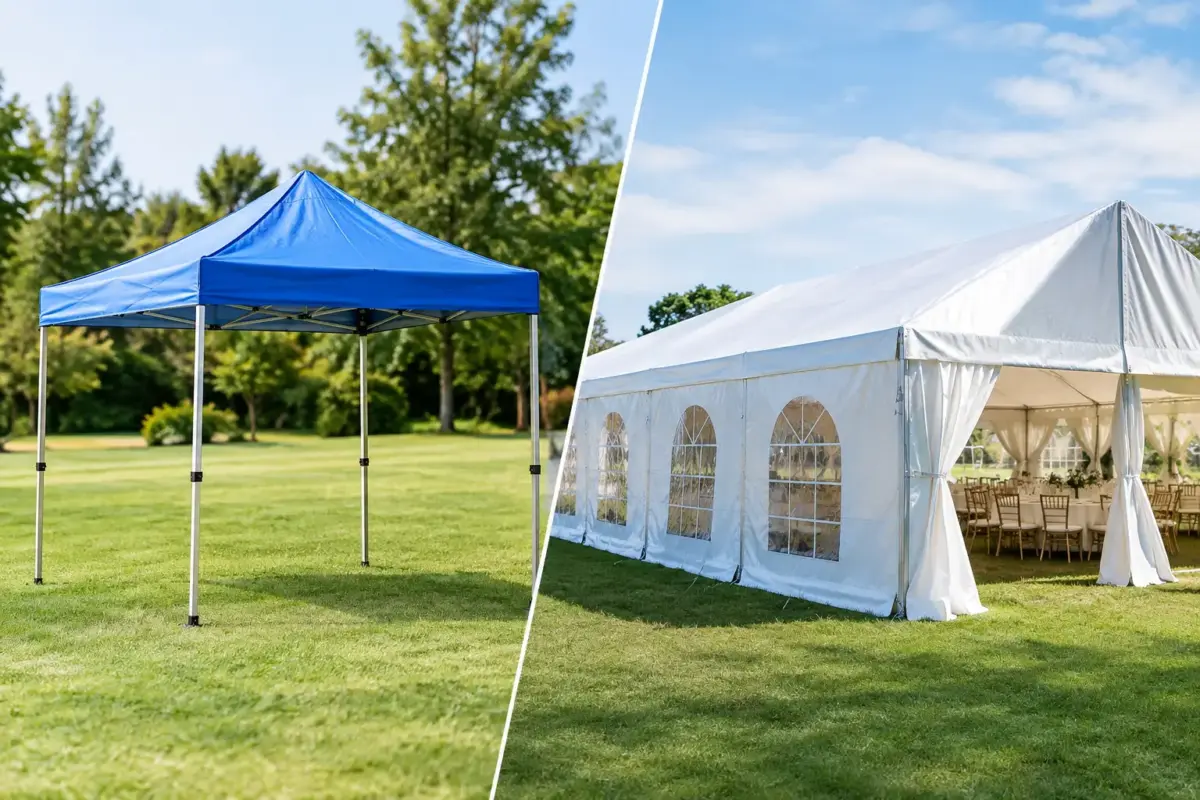
A wet Saturday market, a gusty race day or a busy trade show is a quick test of temporary shelter. The real question in pop up tents versus marquees is not which looks better in a catalogue. It is which structure will set up quickly, carry your brand properly, protect your people and equipment, and keep performing after repeated use.
For Australian businesses, clubs, councils and event teams, the answer often comes down to how you define a marquee. A basic pop-up tent is built for occasional light-duty use. A commercial folding marquee is also a pop-up structure, but it is engineered for regular outdoor work, stronger weather performance and long-term brand presentation. Then there are larger frame, pole and semi-permanent marquees, designed for bigger footprints and longer installations.
Pop Up Tents Versus Marquees: The Core Difference
The terms are used interchangeably, which makes buying harder than it should be. In the broadest sense, a marquee is a temporary covered structure. A pop-up tent is usually a compact shelter with an expanding frame that can be erected in minutes.
The difference is usually in the frame class, fabric, connection points and intended lifespan. Entry-level pop-up tents commonly use lighter steel frames, thinner canopies and simple joints. They may suit a backyard gathering or a once-a-year school stall, but they are not automatically suitable for a windy foreshore, a multi-day festival or a weekly market run.
A commercial folding marquee uses the same fast-deploy concept with more serious hardware. Think reinforced aluminium or steel leg profiles, stronger truss bars, quality connectors, heavier canopy materials and proper anchoring options. It packs down for transport, opens fast on site and gives an organisation a professional shelter it can use again and again.
A larger event marquee is a different proposition again. It generally requires more time, more people and more site planning, but it can cover dining areas, exhibitions, event registration zones or large operational spaces where a 3 x 3 m or 6 x 3 m folding structure is not enough.
When a Pop-Up Shelter Is the Better Call
Speed and mobility matter. If your team is moving between markets, sporting rounds, sampling activations or trade days, a folding pop-up shelter is usually the practical choice. It fits the rhythm of a working event crew: unload from the ute or trailer, expand the frame, fit the roof, secure it correctly and get on with the job.
A 3 x 3 m format is popular because it gives a usable branded footprint without demanding a large crew. It suits market stalls, registrations, merchandise, food service support, first-aid points and product demonstrations. Larger 3 x 6 m and 6 x 6 m options create more room for stock, staff and customers, while still retaining the portability that makes a folding marquee valuable.
Pop-up structures also make sense when brand visibility is a priority. A custom-printed roof turns unused overhead space into a highly visible sign. Printed valances can carry a business name, campaign message or club identity, while branded walls create a cleaner, more enclosed presentation. At a crowded event, that visibility can matter as much as the shade itself.
The catch is that “pop-up” should never mean “disposable”. If it will be used commercially, choose the frame and accessories for commercial work. A cheap shelter that twists in wind, fades quickly or cannot be repaired is rarely a bargain.
When a Larger Marquee Makes More Sense
A traditional frame or event marquee earns its place when the job is less about moving fast and more about covering a substantial area. Consider larger marquees for corporate hospitality, weddings, community events, extended site operations, exhibition spaces and situations where guests need room to circulate under cover.
These structures are also better suited to layouts with flooring, lighting, furniture, multiple entry points or a controlled event perimeter. Their bigger spans can create a more open internal space than several smaller tents placed together.
That capability brings extra requirements. Delivery access, ground conditions, installation time, permits, anchoring methods and pack-down labour all need attention. If the structure will stand for days or weeks, site planning is part of the purchase decision. It is not simply a case of choosing the largest roof available.
For many organisations, the best answer is a mix. A larger marquee can cover the main event zone, while commercial pop-up marquees handle registration, drinks stations, information desks, crew shelter and sponsor activations around the site.
Frame Strength Is Where Value Shows Up
A canopy can look impressive on day one while the frame underneath tells a different story. For recurring events, inspect the engineering rather than judging a shelter by roof colour or a headline price.
Look at the leg profile, wall thickness, truss design, connector material and locking system. Aluminium frames offer excellent corrosion resistance and a manageable carry weight, making them a strong choice for frequent transport and setup. Steel can also be highly capable, particularly in heavy-duty configurations, but frame quality matters more than the material name alone.
The joints deserve close attention. Plastic components can have a place in light recreational tents, but commercial structures benefit from reinforced connection points built to withstand repeated opening, closing and transport. Spare-part availability matters too. A replaceable roof, wall, foot, truss or connector can keep a valuable asset working rather than sending the whole structure to landfill.
For exposed sites, check stated wind ratings carefully and understand the conditions behind them. Selected commercial 3 x 3 m structures can be rated up to 100 km/h when installed as specified, with appropriate tie-down equipment. That rating does not remove the need for event-day judgement. Severe weather, poor ground, damaged components or incorrect anchoring can change the risk quickly.
Do Not Treat Weights and Tie-Downs as Extras
Every outdoor shelter needs a securing plan. This is a safety requirement, not an optional add-on once the wind picks up. The right system depends on your site: grass may allow pegs and ratchet tie-downs, while concrete, bitumen and indoor exhibition floors may require purpose-built leg weights.
Use enough weight for the structure, its size, the weather forecast and the site conditions. Walls increase wind loading, particularly when they are fully enclosed, so they can change what safe setup looks like. Keep access routes clear, check straps and anchor points throughout the day, and lower or pack down the structure if conditions exceed what your equipment and event plan can safely manage.
A professional-looking activation should also be a controlled one. That means no loose legs, no improvised ropes across public walkways and no relying on a couple of sandbags for a large branded roof.
Branding Changes the Buying Decision
A plain shelter provides shade. A printed marquee works as a mobile shopfront. For businesses that exhibit regularly, it can create brand recognition across markets, regional shows, sporting fixtures and trade events before a customer has reached the stand.
Dye-sublimation printing gives colour and graphics that become part of the fabric rather than sitting on top as a temporary finish. That makes it well suited to full-colour logos, photography, patterns and large-format campaign artwork. The result is a more polished presence than a small banner tied to a generic tent.
Plan the design around viewing distance. Your logo should be readable from across an event aisle or oval, not only when someone is standing under the roof. Keep key messages concise, use strong contrast and place essential information on the valances and walls people will actually see. A free visual mock-up before production is useful because it exposes layout problems before the fabric is printed.
Choose by Use Case, Not Just Size
Start with your operating conditions. A weekend market trader may need one person to handle a compact 3 x 3 m commercial folding marquee, wheely bag, walls and weights. A race team may need a larger covered workshop space with awnings, side walls and equipment storage. A council may need several matching branded shelters that can move between community programs, public events and emergency support roles.
Then consider frequency. Once-a-year use may justify a simpler setup, provided it is suitable for the conditions. Weekly or monthly use calls for stronger frames, durable roof fabric, reliable fasteners and a supplier that can provide replacement components. The more often the structure leaves the shed, the more valuable commercial-grade construction becomes.
Finally, consider how your team will transport and set it up. A marquee that is theoretically ideal but too heavy for the available crew, too large for the vehicle or too slow for the bump-in window can become an expensive frustration. Match the shelter to the people operating it.
The Practical Buying Decision
Choose a light-duty pop-up tent only where the risk, frequency and weather exposure are genuinely low. Choose a commercial folding marquee when you need fast setup, repeat use, visible branding and hardware built for Australian outdoor conditions. Choose a larger event marquee when the covered area, internal layout and installation duration demand a more substantial structure.
For most organisations working the event circuit, the sweet spot is a heavy-duty folding marquee with a properly specified frame, custom roof, walls where needed, wheely bag and a real anchoring system. It delivers the mobility of a pop-up with the confidence of commercial equipment.
The best shelter is the one your team can deploy safely, your customers can spot immediately and your organisation can rely on long after the first event is over. Before committing, measure the site, check the forecast realities of your usual locations and specify the frame, printing and tie-down package as one working system.
