
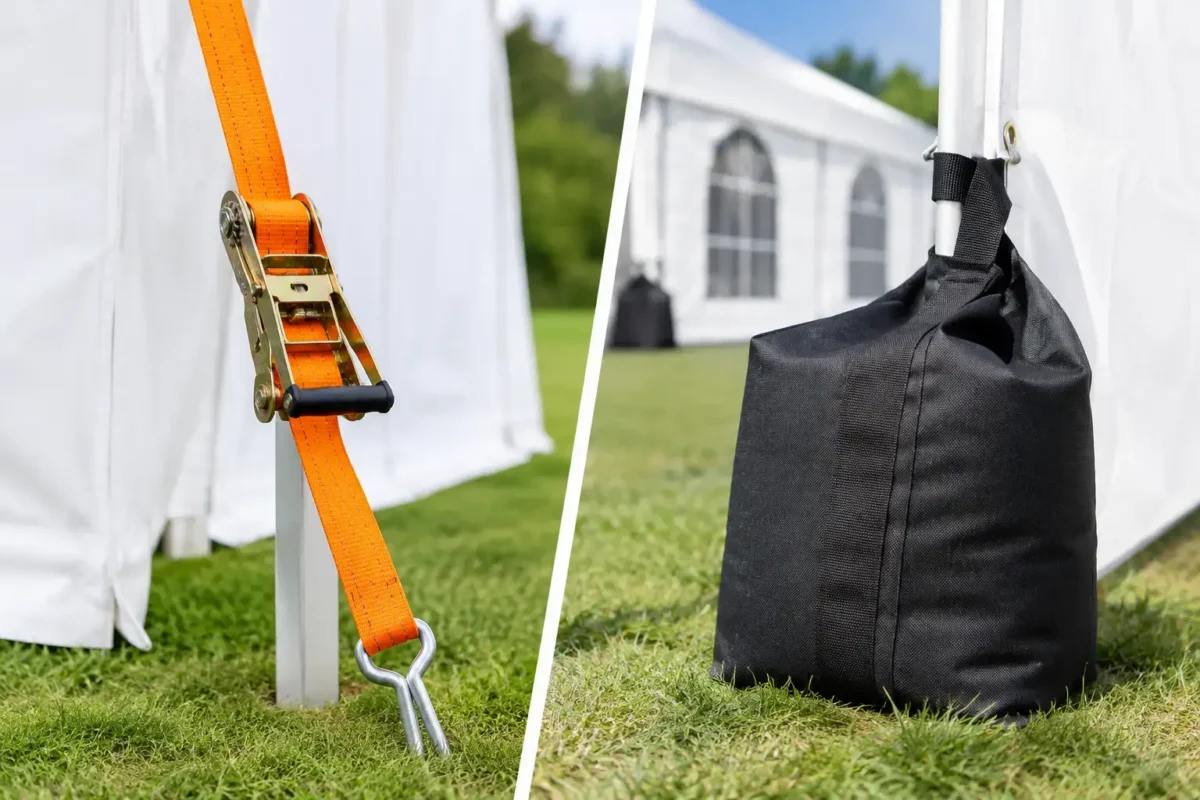
A pop-up marquee can look rock-solid at 8 am, then face a sharp gust across an oval, car park or foreshore by lunchtime. That is why the ratchet straps versus sandbags question is not simply about which accessory is easier to carry. It is about matching your anchoring method to the surface, forecast, crowd exposure and the consequences if conditions change.
For commercial operators, a marquee is shelter, a work area and a highly visible brand asset. It needs to stay put without creating trip hazards, damaging the site or relying on wishful thinking. The strongest setup is often not straps or weights. It is a properly selected combination, installed before the wind arrives.
Ratchet Straps Versus Sandbags: The Core Difference
Ratchet straps restrain a marquee by tying it down to a suitable fixed anchor, such as ground pegs, screw-in anchors or engineered hard-surface anchor points. A tensioned strap resists uplift and sideways movement by transferring load away from the frame and into the ground or anchor.
Sandbags add dead weight at the legs. They are practical where pegs cannot be used, including concrete forecourts, indoor exhibition areas, school quadrangles, bitumen car parks and many council-managed sites. They help resist sliding and make a structure more stable, but they do not provide the same direct resistance to uplift as a correctly installed tie-down system.
That distinction matters. Wind does not only push against a marquee from the side. It can lift under the roof, particularly when doors or sidewalls change airflow. A gust can also shift direction quickly around buildings, grandstands, vehicles and tree lines. Weight alone may be suitable for low-risk, calm conditions, but it is not a blanket answer for exposed outdoor work.
When Ratchet Straps Are the Better Choice
Ratchet straps are generally the stronger option when your site allows secure ground anchoring. They are especially valuable on grass, compacted earth and other surfaces where correctly sized pegs or ground anchors can achieve a reliable hold. Sporting events, regional shows, race days, field activations and outdoor markets often fall into this category.
A quality strap system pulls the frame down and outward, creating a stable footprint. The strap should run from a strong point on the marquee frame to an anchor set clear of the leg, at an angle that supports the structure rather than simply dragging it sideways. Use purpose-built tie-down points where supplied, and follow the manufacturer’s instructions for the specific frame.
The major advantage is performance in variable conditions. If your event is on an exposed oval or a coastal site where gusts are likely, tie-downs should be part of the plan from setup, not an emergency addition. Commercial marquees with stated wind ratings are only capable of their intended performance when they are correctly assembled, anchored and operated within their instructions.
Ratchet straps do have limits. A strap is only as good as its anchor. Thin tent pegs pushed into soft turf, a fence that is not rated for load, a wheelie bin or a random ute tow point are not reliable solutions. Never strap to public infrastructure, trees, barriers or vehicles without permission and confirmation that the anchor is suitable. Poor anchors can fail suddenly and turn a restraint system into a hazard.
Straps also require clear management. Keep them outside pedestrian paths where possible, mark them clearly if they cross a work zone, and use appropriate protection where webbing could rub against sharp edges. Check tension during the day, particularly after rain softens the ground or wind direction changes.
When Sandbags Make More Sense
Sandbags are often the practical choice where penetrating the ground is prohibited or impossible. They are quick to position, easy to move between events and far more site-friendly than pegs on finished surfaces. For an indoor trade show, a covered concourse or a hardstand market site, leg weights are usually the starting point.
The important word is enough. A small bag perched against one leg is not a serious anchoring plan. Weight needs to be distributed across every leg, secured so it cannot slide or become a trip hazard, and selected in line with the marquee manufacturer’s requirements. Purpose-made marquee weight bags or plate systems generally sit closer to the leg and connect more securely than improvised bags of loose material.
Sandbags also suit short-term setups where weather is settled and the site is protected. A school fundraiser in a sheltered courtyard and a morning expo inside a large hall are different operating environments from a long public activation on a windy waterfront. The equipment may be identical, but the risk profile is not.
Be realistic about handling, too. Wet sandbags are heavy, awkward and messy. Repeated lifting can slow your bump-in and strain staff. If your team sets up regularly, purpose-designed stackable weights, carry bags and wheeled transport may be a better long-term operational investment.
Why a Combined Setup Often Wins
Where site rules and surface conditions allow it, use both leg weights and ratchet straps. The weights settle the legs and help resist movement at ground level, while straps provide direct tie-down support against uplift. This layered approach gives an outdoor marquee more security than relying on either system alone.
It is particularly sensible for larger roof areas, long trading days and branded setups with walls, awnings, flags or banners nearby. These additions improve visibility and shelter, but they can also change how wind loads act around your site. Sidewalls should never be added casually in rising wind. They can catch air and materially increase the load on the frame and anchors.
A combined system is not a licence to operate in unsafe weather. If gusts build beyond the safe operating conditions for your marquee, stop trading or activating, clear people from the area, remove sidewalls if safe to do so, and pack down when conditions permit. No amount of extra sand can turn an unsuitable weather window into a safe event.
Match the System to Your Surface and Use Case
Start with the site surface. On grass or soil, ask whether pegs or screw anchors are permitted and whether the ground is firm enough to hold them. On concrete or bitumen, confirm whether fixed anchors are available. If not, plan for adequate weights on every leg and assess whether the forecast supports operating there at all.
Then consider the marquee itself. A lightweight promotional gazebo, a heavy-duty commercial folding marquee and a larger semi-permanent structure have different frame capacities, roof areas and anchoring requirements. Do not assume an accessory that worked on a 2 x 2 m canopy will be appropriate for a 3 x 6 m marquee. Bigger roof area means more wind force, even when the breeze feels manageable at ground level.
Finally, consider exposure and public risk. A marquee beside a quiet warehouse may have a different plan from one at a busy community event with prams, queues, food service and stock underneath. If a structure moves, who could be affected? That answer should shape your anchoring standard.
Setup Checks That Protect Your Team and Brand
Before raising the roof, inspect the frame, roof fabric, connectors, straps, ratchets and anchor points. Replace worn webbing, bent pegs and damaged hardware rather than hoping they will last one more event. A heavy-duty marquee performs best when its accessories are maintained to the same standard.
Once anchored, walk the perimeter. Confirm every leg is weighted or tied down as required, ratchets are tensioned without crushing the frame, and straps are not creating avoidable hazards. Check that walls, awnings and signage are fitted correctly. Keep an eye on the weather rather than relying on the morning forecast, and nominate one person who can make the call to adjust or pack down.
For recurring activations, document what worked at each venue. Record the surface, wind exposure, weights used, anchor type and any restrictions from venue management or councils. That turns setup knowledge into a repeatable system, especially when different staff or volunteers are on the job.
The right choice is rarely about buying the heaviest bag or the longest strap. It is about building a complete restraint plan around your marquee, your location and the conditions you may face. Get that right, and your shelter will look professional, protect the people beneath it and keep your brand standing tall when the weather starts asking questions.
