
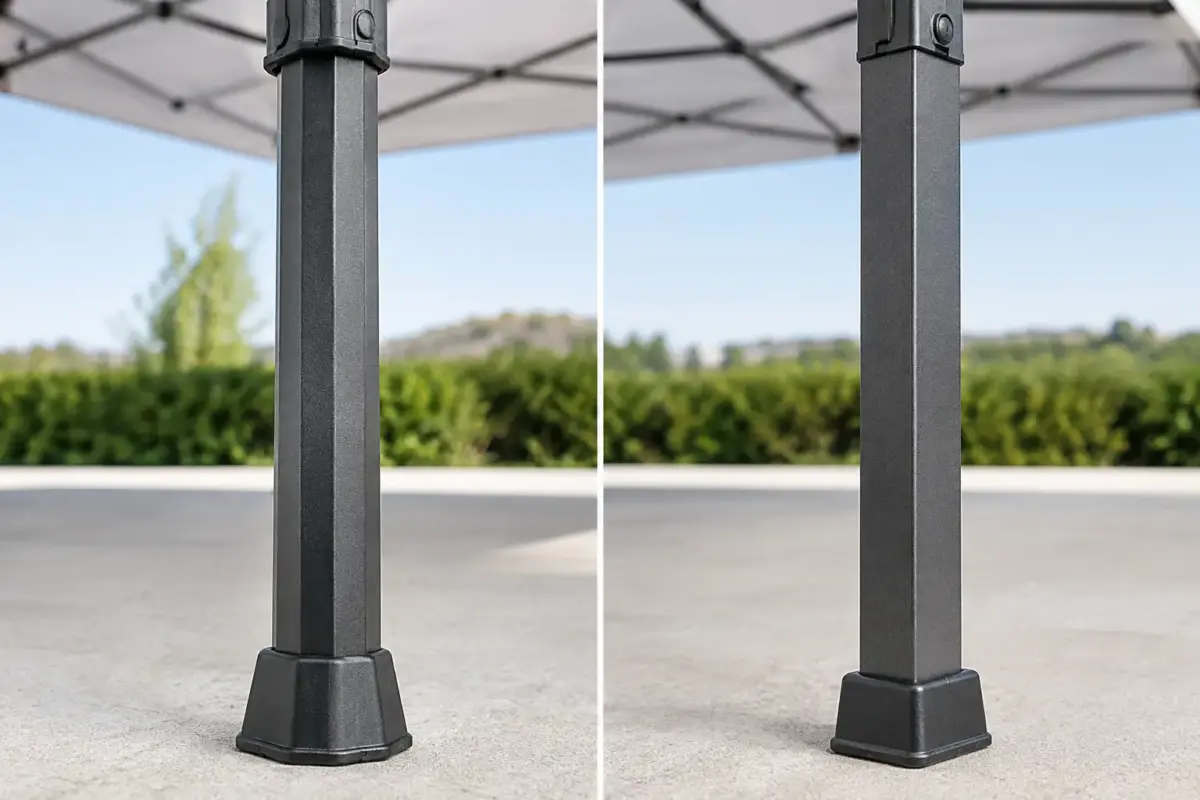
A marquee can look the part in a product photo, then tell a different story halfway through a windy Saturday market. When comparing hexagonal versus square marquee legs, the visible shape is not just a design detail. It affects how the frame resists movement, handles repeated use and supports your roof, walls, printed branding and tie-down equipment.
For businesses, clubs and event teams that use their shelter more than a few times a year, the right leg profile should be assessed alongside frame material, wall thickness, connector design, roof fabric, warranty and anchoring system. A leg profile alone does not make a marquee commercial-grade. But it is a useful indicator of what the frame has been designed to do.
What the leg profile actually changes
The legs are the load path between the roof structure and the ground. Wind pushes against the roof and walls, people lean on the frame, and the marquee is opened, packed down and transported again and again. Every one of those forces travels through the legs, brackets and connectors.
Square marquee legs have four flat sides and are common across entry-level and many mid-range folding marquees. They are straightforward to manufacture, easy to measure and can deliver good service where the frame uses quality aluminium or steel, sensible wall thickness and properly engineered joints.
Hexagonal legs use a six-sided profile. More faces around the tube can help distribute force differently than a square profile, while giving the leg more resistance to twisting under load. This is one reason hexagonal profiles are often specified in heavy-duty commercial frames designed for frequent outdoor work.
The practical point is simple: profile geometry matters, but the entire frame determines performance. A thin hexagonal tube with weak connectors is not automatically stronger than a well-built square-leg frame. Ask for the complete specification, not just the shape of the legs.
Hexagonal versus square marquee legs for heavy-duty use
If your marquee is doing occasional backyard duty, square legs may be all you need. If it is travelling to markets every weekend, supporting printed walls at a sporting event or operating as a council information point, the calculation changes.
Torsional strength and frame movement
Torsion is twisting force. It shows up when gusts hit one side of a marquee, when the ground is uneven, or when a team member lifts one corner before the rest of the frame is ready. A hexagonal profile can offer improved resistance to rotational movement because its geometry has more faces supporting the tube’s shape.
That does not mean a hexagonal frame is immovable. Any folding marquee needs correct anchoring, especially when walls are fitted. Walls create a larger surface for wind to catch, so weights, pegs and tie-down straps are not optional extras in exposed conditions. They are part of the operating system.
Square legs can still perform well for lighter promotional jobs and sheltered locations. They are also widely used, which can make replacement components and accessory compatibility simpler in some ranges. The key is matching the frame grade to the conditions, event frequency and equipment you intend to add.
Load distribution at joints and brackets
Legs do not work in isolation. The upper sliders, truss bars, corner connectors and locking mechanisms take substantial stress every time the marquee opens and closes. A premium frame needs solid connection points that keep the roof structure aligned and avoid excessive play over time.
Hexagonal legs are commonly paired with reinforced commercial hardware because that profile is aimed at demanding use. But this is not a rule. Check whether the connectors are metal or plastic, how the trusses attach, whether the locking pins are protected, and whether spare parts are available. A marquee that can be repaired is a much better long-term asset than one headed for landfill after a damaged bracket.
Weight, handling and transport
A stronger frame can weigh more. That is a trade-off worth making for many professional users, but it needs to suit your crew and transport setup. A bulky frame may be perfect for a race team with a ute and several hands on site, yet inconvenient for a sole trader regularly setting up alone.
Hexagonal commercial legs are often found on frames built with thicker materials and stronger fittings, which can add weight compared with lighter square-leg models. A wheely bag makes a real difference here, particularly when moving equipment across car parks, ovals or exhibition halls.
Do not choose the lightest option simply because it is easier to lift once. Consider the whole job: loading the vehicle, setup time, pack-down, outdoor exposure and how many seasons you expect the marquee to deliver.
Frame material and wall thickness matter as much as shape
The question is not only square or hexagonal. It is aluminium or steel, tube diameter, wall thickness, truss construction and hardware quality.
Aluminium frames are popular for commercial marquees because they offer a strong strength-to-weight balance and resist corrosion well. Steel can provide excellent strength and may suit certain applications, but it generally adds weight and needs suitable surface protection for outdoor use.
Wall thickness affects how readily the tube can flex or dent. A larger-looking leg with a thin wall is not necessarily stronger than a slightly smaller profile built from thicker, better-quality material. This is why vague claims such as “heavy duty” should be backed by clear frame specifications.
For ongoing promotional work, look for a supplier that states the frame profile, materials and intended application. If a wind rating is quoted, check what size marquee it applies to, what anchoring method is required and whether that rating assumes particular roof or wall configurations. Wind performance is a system outcome, not a number printed on a sales page.
Which leg profile suits your application?
A square-leg marquee is often a sensible choice for occasional markets, school stalls, indoor trade displays, community days and lower-exposure setups where portability and budget are priorities. It can also be the right option when you need several shelters for short-duration events and each one will receive careful handling.
A hexagonal-leg marquee is usually the stronger fit for regular outdoor trading, motorsport pits, sporting clubs, field operations, touring activations and branded event infrastructure. These applications place more demands on the frame through travel, repeat setup and changing weather. The higher initial spend can make commercial sense when the marquee remains presentable, functional and repairable across years of use.
For a custom-printed marquee, frame quality deserves even more attention. Your roof and walls carry your logo, colours and message at eye level. A sagging, unstable or tired-looking frame undermines that investment. A strong structure helps your branding stand taller and look sharper on site.
Questions worth asking before you buy
Before selecting either profile, get clear answers on the details that affect day-to-day performance. Ask what material the legs and trusses are made from, how thick the tube walls are, what the connectors are made from and whether the frame has replaceable parts.
Also ask what is included. A commercial marquee package should be considered with its carry bag, roof, walls, weights, pegs and tie-down straps. Buying the frame without a proper anchoring plan is false economy, particularly in Australian conditions where a calm morning can turn into a gusty afternoon.
If you are comparing quotes, make the comparison fair. Put size against size, include printing where required, and compare the complete accessory package rather than just the headline price. A cheaper marquee can become expensive quickly if it needs replacing after a season or cannot be repaired when a part is damaged.
Build the marquee around the job, not the catalogue label
There is no universal winner in hexagonal versus square marquee legs. Square legs can be practical and cost-effective for lighter, controlled use. Hexagonal legs often make more sense where strength, repeated deployment and outdoor confidence are non-negotiable.
Mountain Shade customers often need more than a temporary shelter. They need a dependable branded base for trading, competing, informing the public or running an event. Start with the conditions your marquee will face, choose a frame that suits that workload, and make sure the anchoring and accessories are ready for the same job. The best leg profile is the one supported by a properly engineered frame and used with the discipline outdoor work demands.
