
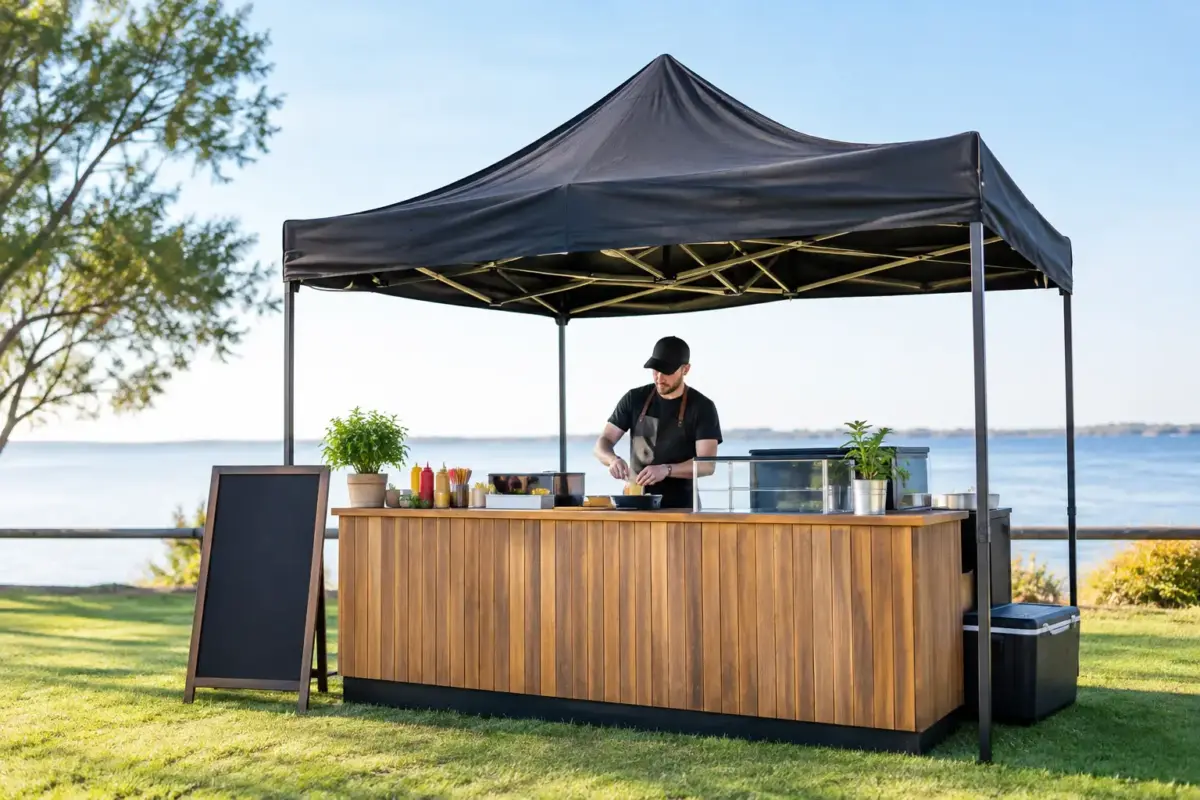
A food stall can look busy for the right reason – great product, fast service and a queue that keeps moving – or for the wrong one: staff colliding, stock piled beside the till and customers standing in the rain. Choosing the best gazebo sizes for food stalls starts with the way you actually trade, not simply the footprint of the site you have booked.
For Australian markets, festivals and sporting events, a gazebo is operational infrastructure. It needs to protect staff, food and equipment, give your brand a strong street presence, and stand up to sun, wind and a long day on hardstand or grass. The right size gives you room to work safely. The wrong size can restrict sales before the event even starts.
Best gazebo sizes for food stalls: start with the menu
The menu determines your equipment load, and your equipment load determines the gazebo size. A stall selling packaged sweets has very different needs from a coffee cart, burger operation or fresh-cooked catering setup.
A compact 3 x 3 m gazebo gives you nine square metres of covered space. It is the workhorse size for simple market setups: coffee and cold drinks, bakery products, confectionery, sauces, produce or pre-packed meals. It is also a practical choice where market organisers allocate standard 3 m sites and access is tight.
That said, nine square metres disappears quickly. Put in a 1.8 m trestle table, an upright fridge, an espresso machine or a hot display cabinet, an EFTPOS point and two staff members, and movement becomes limited. A 3 x 3 m structure works best when the offer is focused, the stock level is controlled and most customer service happens from the front edge.
For many growing operators, 3 x 4.5 m is the sweet spot. The extra 4.5 square metres may not sound dramatic, but it creates a meaningful work zone behind the serving counter. You can separate taking orders from preparing food, store packaging out of sight and retain a clearer path for staff. It is a strong fit for coffee stalls, smoothie bars, dessert traders and operators using one or two pieces of benchtop cooking equipment.
A 3 x 6 m gazebo is built for higher-volume food service. With 18 square metres under cover, it can support a proper front-of-house counter, cooking or preparation space, cold storage and a rear stock area. This size suits burger stalls, barbecue vendors, loaded food concepts, caterers and brands that need multiple staff serving through peak periods.
The trade-off is straightforward: bigger structures need more site frontage, more time to set up and greater attention to weights, tie-downs and access. But if a cramped layout is slowing service, a larger commercial marquee often pays for itself through better throughput and a more professional customer experience.
Match the canopy to the stall layout
Do not measure only the equipment. Measure the people using it and the direction they need to move.
A food stall normally needs four functional zones: customer service, food preparation, storage and staff access. In a small stall, those zones overlap. In a busy operation, they should be deliberately separated. A customer should be able to order and pay without stepping into the service path, while staff should not need to squeeze past hot equipment every time they reach for cups or packaging.
For a 3 x 3 m gazebo, place the service table across the front and keep preparation behind it. Use the rear area for compact shelving, an esky or limited stock. If customers can order at one side and collect at the other, even a small space can feel faster and more organised.
With a 3 x 4.5 m gazebo, use the long front edge to create a clearer ordering and collection system. This works particularly well when one team member takes payment while another prepares drinks or plates food. A half wall or branded counter skirt can help define the customer boundary without closing off the stall.
Under a 3 x 6 m gazebo, it is easier to build an efficient production line. For example, orders can enter at one end, move through cooking and finishing, then leave from a separate collection point. This layout keeps queues moving and protects staff concentration during a rush.
If your service is primarily from a trailer, van or food cart, the gazebo may be less about fitting the kitchen and more about sheltering the queue, payment point or condiments station. A 3 x 3 m or 3 x 4.5 m canopy can add valuable covered customer space beside the main unit. Check the total site allocation before committing to the layout.
Think beyond the trading footprint
The best gazebo size is not always the largest one that fits on paper. Event sites often include constraints such as neighbouring vendors, fire lanes, public walkways, vehicle access and stipulated setbacks for cooking equipment. Some organisers also require clear exits, specific gas-bottle placement and fire-safety equipment on site.
Before buying, ask for the site plan and confirm whether the quoted bay size includes room for walls, awnings, queue barriers and weights. A 3 x 6 m stall placed in a 3 m-deep site may fit exactly, but there may be no space to safely manage a customer queue at the front.
Also consider transport. A commercial folding gazebo should pack down efficiently enough to load into your ute, van or trailer, but the frame, roof, walls, weights, tables and cooking equipment all add up. Larger structures remain highly portable, yet they are best handled by a crew that has rehearsed the setup process.
Why frame grade and weather protection matter
Food trading does not pause because the weather turns. On a hot summer day, the roof protects staff and products from direct sun. In a shower, sidewalls can protect stock and prep areas. In gusty conditions, frame strength and correct anchoring become non-negotiable.
A lightweight promotional gazebo may be acceptable for occasional, low-risk use, but food stalls often work long hours in exposed locations. Choose a heavy-duty commercial frame with strong leg profiles, reinforced joints and a roof made for repeated use. This is where buying for the lowest upfront price can become expensive: a bent frame or damaged roof can cost you a trading day.
Wind ratings should be read carefully. They apply only when the gazebo is correctly installed, secured and used within the manufacturer’s stated conditions. A selected 3 x 3 m commercial structure may carry a wind rating up to 100 km/h, but that does not mean leaving it unattended in severe weather or treating weights as optional.
On grass, use suitable pegs and tie-down straps where venue rules allow. On concrete, asphalt and indoor floors, use correctly rated leg weights. Every leg needs securing, and larger structures may need additional tie-down points. Never rely on a couple of light sandbags to hold down a working food stall in a gusty paddock or coastal event site.
Roofs, walls and branding that earn their space
A plain roof gives shelter. A custom-printed roof turns the same structure into a sign visible across a busy market. For food businesses competing among dozens of traders, that visibility matters before customers are close enough to read the menu.
Use the roof valance for your trading name, key product or logo, then keep the message simple. A customer walking past should understand what you sell in seconds. Full printed walls can add colour and impact, while a half wall is useful for hiding storage tubs, power leads and spare packaging beneath the counter.
Walls should be selected for operations, not decoration alone. A rear wall protects stock and gives your stall a cleaner backdrop. Sidewalls can reduce wind and low-angle sun, but fully enclosing a hot cooking environment can create heat and ventilation problems. If you use gas, fryers, barbecues or other heat-producing equipment, follow event rules, appliance guidance and local requirements for clearances and airflow.
Mountain Shade structures are designed for commercial operators who need a strong frame, dependable accessories and print that keeps working event after event. That makes sense when your gazebo is doing double duty as shelter and one of your most visible brand assets.
A practical size guide for common food setups
A 3 x 3 m gazebo is generally right for a solo trader or two-person team selling coffee, cold drinks, bakery goods, packaged food, produce or a tightly edited menu. Keep equipment compact and avoid trying to run a full kitchen from this footprint.
A 3 x 4.5 m gazebo suits businesses that need a little production space behind the counter. Think espresso service, acai bowls, crepes, sweets, ready-to-serve meals or a small barbecue setup where stock and packaging must stay protected.
A 3 x 6 m gazebo is the better call for high-volume cooking, several staff, a long menu or a distinct order-and-collection flow. It is also a smart choice for caterers who attend recurring festivals and need room to trade without constantly rearranging the workspace.
Two connected gazebos can be more effective than one oversized footprint when you need separate functions. One bay can handle cooking and preparation, while the other manages ordering, collection or seating cover. This approach adds flexibility, although it requires careful joining, drainage planning and enough weights for every leg.
Choose the footprint that lets your team move with purpose, keeps customers out of the work zone and gives your brand room to be recognised from across the event. When the lunch rush arrives, that extra metre of clear workspace can be the difference between merely having a stall and running one that performs.
