
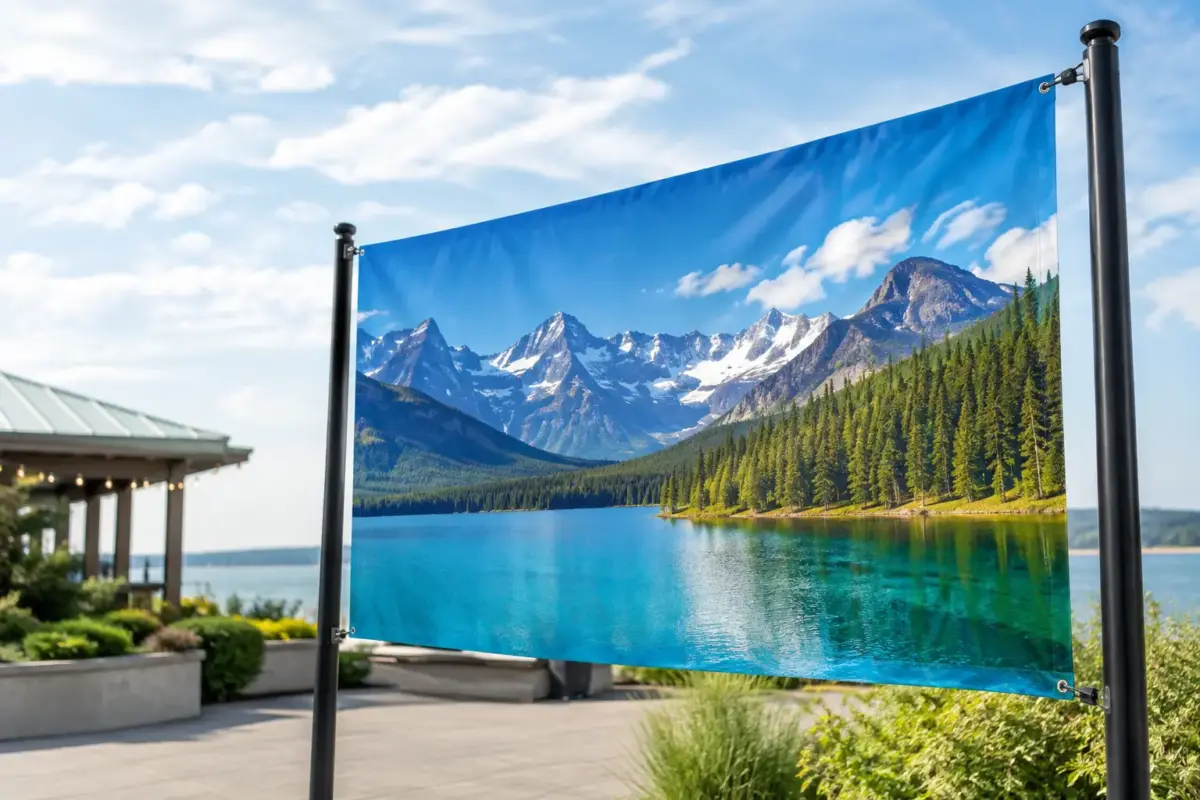
A banner that looks sharp at pack-in can look tired by lunchtime if the print, fabric or hardware is not built for the job. Dye sublimation banners give Australian businesses, clubs and event teams a stronger way to carry their branding through markets, race days, council activations and outdoor promotions – with colour that is embedded into the material, not simply applied to its surface.
For organisations that work outside, that difference matters. Your signage has to attract attention from across a busy oval, footpath or exhibition aisle, then keep doing its job through wind, handling, transport and repeated setup. The right banner becomes a reusable brand asset rather than another disposable event cost.
What makes dye sublimation banners different?
Dye sublimation is a heat-transfer printing process designed for polyester fabrics. Artwork is printed using specialist inks, then heat and pressure turn the ink into gas so it bonds with the polyester fibres. The result is a permanent, full-colour print that becomes part of the fabric itself.
That is different from a surface print sitting on top of a substrate. With dye sublimation, the fabric stays soft, flexible and easy to fold. Colours remain vibrant, gradients reproduce cleanly and the design will not crack or peel when the banner is packed into a bag after a long event day.
For branded flags, fabric banners, media walls and marquee walls, this process creates a more premium finish. It is particularly effective where your artwork includes detailed logos, photographic imagery, colour transitions or large blocks of brand colour that need to look consistent at scale.
Better visibility starts with the right banner format
Not every site needs the same signage. A banner placed beside a trade stand has a different job from one positioned at the entrance to a sporting ground. The most effective choice depends on viewing distance, available space, ground conditions and whether people will see it while walking, driving or standing in a queue.
Feather and teardrop flags
Feather and teardrop flags are made to be noticed. Their height gets your branding above tables, vehicles and crowds, while the moving fabric catches the eye in a light breeze. They are a practical choice for open days, dealerships, market stalls, school events and race teams that need to mark out a presence quickly.
A teardrop shape holds a more stable display profile in calmer conditions. Feather flags provide a taller, more vertical shape and can suit designs with stacked wording. In either format, keep the key message high on the flag and use large, simple elements. Fine print may look great on screen but disappears when viewed from the other side of a car park.
Fabric banners and media walls
Straight fabric banners and media walls work best where people are closer to the message. Think trade shows, presentation areas, registration points, sponsor backdrops and community events. A dye-sublimated fabric finish gives these displays clean colour and a professional, low-glare appearance in photos.
For media walls, repeat logos at a sensible scale rather than making them too small. The wall should work from several metres away and in close-up content. If it will be used for interviews, award photos or social posts, consider where faces will sit so important logos are not covered.
Banner walls for branded shelter
A printed marquee roof gets attention from a distance, but branded walls close the gap at eye level. They can define your footprint, create a more sheltered working area and carry service information, sponsor logos or campaign messaging. This is where dye sublimation is especially useful: full-panel graphics can turn a standard setup into a highly visible branded structure.
Colour, detail and double-sided printing
The biggest visual advantage of dye sublimation banners is the quality of the print. Strong spot colours, subtle gradients and high-resolution images can all be reproduced with impressive clarity when supplied as suitable artwork. However, printing quality cannot repair a poor logo file.
Use vector artwork for logos and type wherever possible. Vector files scale cleanly for large-format printing, while low-resolution screenshots and web images can become soft or pixelated. If photographs are part of the design, they need enough resolution at the final print size – not just enough to look acceptable on a mobile screen.
Many fabric flags are printed so the design shows through to the reverse side. This creates an effective mirrored image on the back and is often ideal for logos and bold graphics. Where exact readability is required from both sides, a true double-sided construction may be the better choice. It generally adds weight and cost, but it gives you a correctly oriented message on each face.
The decision comes down to use. A simple logo flag at a busy market can work brilliantly with show-through printing. Directional messaging, detailed text or a sponsor board viewed from both directions may justify double-sided production.
Built for the Australian event circuit
Print is only one part of a banner system. A great-looking flag that has a weak pole, unsuitable base or poor-quality stitching will not perform when conditions change. Outdoor signage needs to be chosen as a complete setup.
For grassed sites, a ground spike can provide a secure, low-profile solution where site rules allow it. On concrete, pavers and indoor floors, cross bases and weighted bags offer flexibility. Drive-on bases can be useful where a vehicle is already part of the activation. The correct base is determined by the surface and wind exposure, not simply what is easiest to carry.
Wind is the issue that deserves the most respect. Tall flags and banner systems create load as the wind increases, particularly on exposed ovals, beachfront sites and open car parks. Do not treat a banner as a set-and-forget item. Check the forecast, use the recommended weights or anchoring system, inspect poles and fittings, and bring the display down if conditions become unsafe.
The same principle applies to printed marquee walls. They add valuable branding and weather protection, but they also change how wind moves around a structure. Commercial-grade frames, proper tie-downs, weights and active site management are part of responsible outdoor operation.
How to design a banner people can actually read
A banner is not a brochure. It has seconds to make an impression, often while the audience is moving. The strongest designs usually have one clear priority: your business name, event message, offer or location marker.
Start with the logo, then choose one supporting message. Use high contrast between the background and wording, particularly for outdoor use. Dark text on a busy photographic background may technically be present, but it will not do the hard work of attracting customers.
Avoid trying to list every service you offer. A flag that says who you are and where to find you is more effective than a flag crammed with phone numbers, social icons, a paragraph of copy and six product images. Your staff, table displays and printed collateral can handle the detail once people have walked over.
If your organisation attends multiple types of events, plan a flexible banner kit. A branded marquee and general-purpose flags can be used everywhere, while campaign-specific banners can be added for a product launch, membership drive, fundraising day or seasonal promotion. This keeps your core equipment working across the year without forcing every activation into the same message.
Protecting your investment between events
Dye-sublimated fabric is designed for repeat use, but it still needs sensible handling. Allow banners to dry before packing them away, especially after rain or morning dew. Folding damp fabric into a bag can lead to odour, mildew and staining that no amount of good print quality can hide.
Keep poles, bases and connectors together in their proper bags or cases. Check for bent sections, damaged clips and worn stitching before the next event rather than discovering a problem during bump-in. For teams that travel frequently, spare parts availability is a real operational advantage. A replaceable pole section or base component is far more practical than writing off an otherwise serviceable display.
Cleaning should be gentle. Follow the care advice for the particular fabric and hardware, avoid harsh chemicals, and do not use high heat that may affect the material. Most importantly, assign someone to own the kit. Branded equipment lasts longer when it is treated as business infrastructure, not leftover promotional gear.
Get the print and hardware working together
The best dye sublimation banners do more than display a logo. They help customers find you, give staff a professional base of operations and make your organisation look established wherever it sets up. When flags, banner walls and a heavy-duty printed marquee are designed as one system, the result is hard to miss.
Mountain Shade can help turn existing artwork or an early concept into a practical display package, with free visual mock-ups available before production. Choose the format for the site, match it with hardware that suits the surface and conditions, and keep the message bold enough to earn attention from the first glance.
